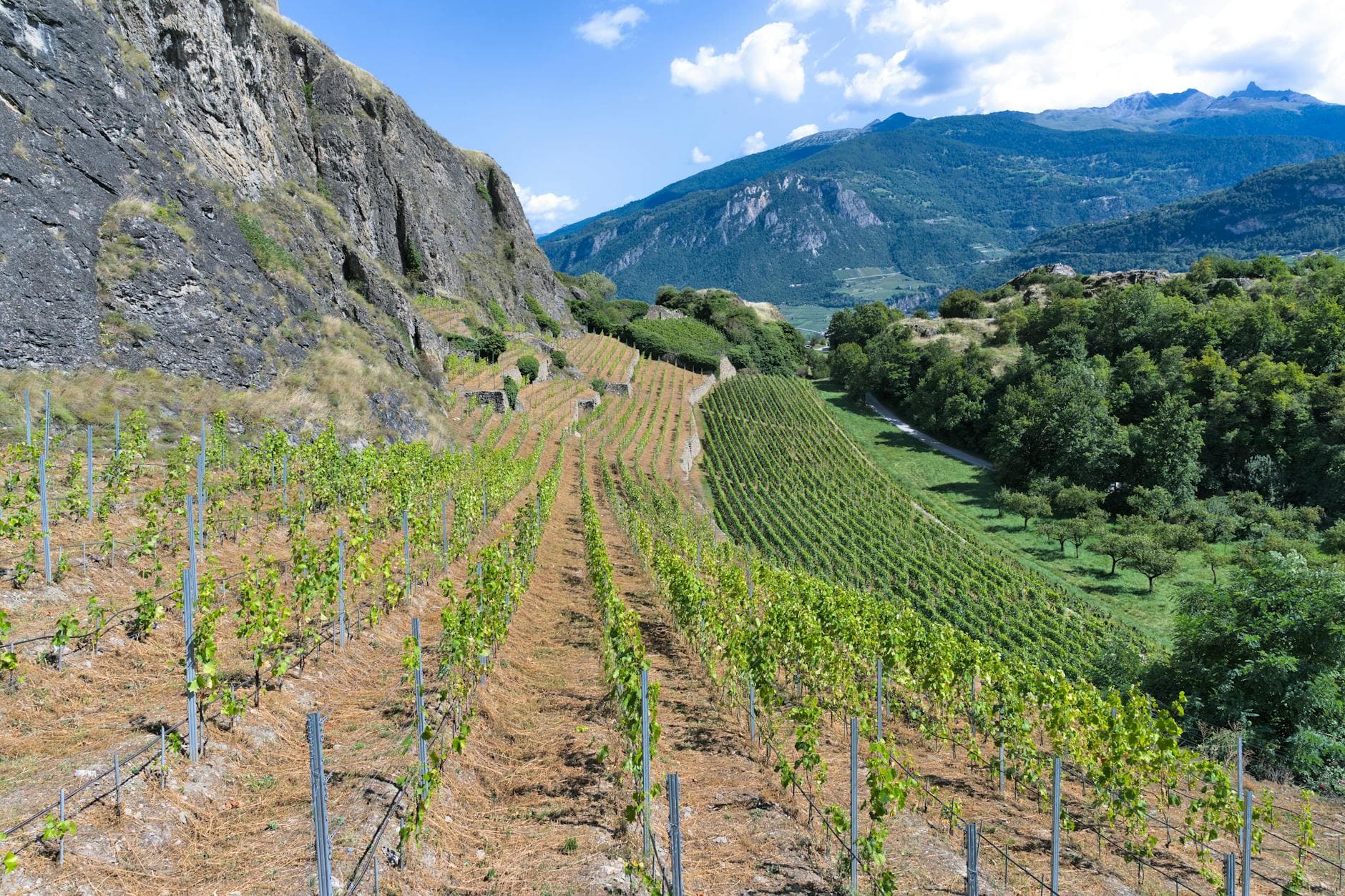
 Photo: Jean-Paul Wettstein / Pexels
Where to Stay in Valais Wine Country: Complete 2026 Guide
Find the best places to stay in Valais, Switzerland's largest wine region. From Sion's twin castles to the highest vineyards in Europe at Visperterminen, discover where to base yourself for tasting Fendant, Petite Arvine, Cornalin, and Humagne Rouge.
Planning a trip to Where to Stay in Valais Wine Country: Complete 2026 Guide?
Compare hotels, vineyard B&Bs and rentals across Booking, Airbnb and more in one search.
The Rhône Valley cuts through the Swiss Alps like a sun-drenched corridor, and Valais fills every metre of it with vines. Switzerland's largest wine canton stretches 100 km from Martigny in the west to Visp in the east, its south-facing terraced slopes rising from the valley floor at 500 m to well above 1,100 m—some of the highest vineyards anywhere in Europe. The dry Föhn wind sweeps down the valley, the sun beats off the rock faces, and ancient bisses (irrigation channels carved into mountainsides centuries ago) deliver glacial meltwater to vines that would otherwise parch. Valais produces a third of all Swiss wine, yet almost none of it leaves the country. The grapes here are unlike anything you will find in France, Italy, or Germany: Fendant (the local name for Chasselas), Petite Arvine, Amigne, Humagne Blanche, Cornalin, Humagne Rouge, and Heida (Païen)—indigenous Alpine varieties that have grown in these terraces since Roman times.
What makes Valais singular is the collision of extremes. You can ski at 3,000 m in the morning and taste red wine from century-old Cornalin vines after lunch. The valley floor is warm enough for apricots; the upper slopes cold enough for ice wine. Terraced vineyards held together by dry-stone walls rise at angles that would make a Mosel winemaker wince. The canton is officially bilingual—French in the west (Bas-Valais), German in the east (Oberwallis)—and this linguistic divide produces noticeably different wine cultures within the same region. Prices are Swiss, which means steep, but the wines are unreplicated anywhere else on earth. If you drink Petite Arvine or Cornalin outside Valais, you almost certainly drank it at a Swiss restaurant—because the export market barely exists.
Best Areas to Stay in Valais Wine Country at a Glance:
- For the wine capital: Sion — twin hilltop castles, restaurants, central Rhône Valley location
- For sun and Pinot Noir: Sierre / Salgesch — sunniest town in Switzerland, red wine heartland, wine museum
- For the western gateway: Martigny — Fondation Gianadda museum, lower Valais wines, closest to Geneva
- For extreme altitude wine: Visp / Visperterminen — highest vineyards in Europe, Heida at 1,150 m
- For mountain luxury: Crans-Montana — panoramic Alpine terrace, skiing, summer hiking among vines
Best Areas to Stay for Wine Tasting
Sion
Sion is the cantonal capital and the natural centre of gravity for any Valais wine trip. Two medieval fortifications—the Basilique de Valère and Château de Tourbillon—sit on twin rocky hills above the old town, creating one of the most distinctive skylines in Switzerland. The old town below has Roman foundations, a 12th-century cathedral, and narrow streets lined with cafés and wine bars that pour local bottles by the glass. More importantly, Sion sits dead centre in the Rhône Valley, making it the most efficient base for reaching every sub-region in Valais.
Why wine lovers choose Sion:
- Central location—Sierre 15 minutes east, Martigny 20 minutes west, vineyards in every direction
- Best restaurant and wine-bar density in the canton (La Sitterie, L'Enclos de Valère, Café de la Grenette)
- Saturday market with local cheeses, dried meats, and wine direct from small producers
- Valère basilica houses the oldest playable organ in the world (circa 1435)
- Direct train from Geneva (1h 50min), Zurich (2h 40min), and Milan via Simplon (3h)
- Cave ouvertes (open cellar events) within walking or short driving distance in spring
Price range: CHF 140–380/night
Best for: First-time visitors, food-and-wine travellers, those without a car on arrival
Wine access: Walk to wine bars in the old town for flights of Fendant, Petite Arvine, and Cornalin. A car opens up dozens of producers in Conthey, Vétroz, Savièse, and Saint-Léonard within 10–15 minutes. The Caves du Château at Sion's municipal tasting room pours a wide rotation of local producers.
Trade-off: Sion is a working town, not a resort—expect administrative buildings alongside the medieval charm. Less scenic than Crans-Montana, less intimate than Salgesch.
Where to stay: Hôtel des Vignes, set right among the vineyards, or Hotel Castel, below Tourbillon Castle a few minutes from the centre.
Sierre / Salgesch
Sierre holds the title of the sunniest town in Switzerland, with over 300 days of sunshine per year—a statistic that explains why this stretch of the Rhône Valley produces the canton's finest red wines. Just east of Sierre, the village of Salgesch (Salquenen in French) is the undisputed capital of Swiss Pinot Noir, its south-facing slopes yielding structured, mineral reds that regularly beat expectations at blind tastings. The Musée Valaisan de la Vigne et du Vin (Valais Wine and Vine Museum) occupies two sites—Château de Villa in Sierre and the wine museum in Salgesch—connected by a walking path through vineyards called the Sentier Viticole.
Why wine lovers choose Sierre / Salgesch:
- Pinot Noir heartland—Salgesch's best bottles rival mid-tier Burgundy at a fraction of the price
- Sentier Viticole vineyard walk (6 km) between Sierre and Salgesch with information panels on grape varieties and terroir
- Château de Villa houses a wine bar, raclette restaurant, and regional tasting room
- Quieter and more wine-focused than Sion, with a genuine village atmosphere in Salgesch
- Gateway to Val d'Anniviers—spectacular Alpine valley with traditional wooden villages and summer hiking
- Annual "Vinea" wine fair in Sierre (September)—the largest open-air wine salon in Switzerland
Price range: CHF 120–320/night
Best for: Red wine enthusiasts, walkers, those who want to be inside wine country rather than beside it
Wine access: Outstanding for reds. Walk from Salgesch to producers like Domaine Cornulus, Cave Gérald Besse, or Adrian & Diego Mathier. Sierre's Château de Villa pours 600+ Valais wines. The Sentier Viticole lets you taste the terroir on foot, literally walking between domaines.
Trade-off: Fewer restaurants and evening options than Sion. Salgesch is a village—expect to eat at your hotel or drive for variety. The linguistic border runs through Sierre (French to the west, German to the east), which can be mildly confusing.
Where to stay: Hotel Le Mont-Paisible in Sierre, near Château de Villa's 600-plus Valais wines, or Hôtel La Prairie in Salgesch, steps from the Wine Museum.
Martigny
Martigny sits at the elbow where the Rhône turns north toward Lake Geneva, making it the first (or last) wine town for travellers coming from Geneva, Chamonix, or the Great St Bernard Pass from Italy. The town punches well above its weight culturally: the Fondation Pierre Gianadda hosts world-class art exhibitions (Picasso, Monet, Klee), a Gallo-Roman museum built around an excavated Roman temple, and a sculpture park. Lower Valais vineyards around Martigny, Fully, and Saillon tend toward white varieties—Fendant, Petite Arvine, and the rare Amigne de Vétroz.
Why wine lovers choose Martigny:
- Fondation Gianadda—one of the best private art museums in Europe, set in Roman ruins
- Gateway to Fully and Saillon, where steep terraced vineyards produce exceptional Petite Arvine
- Closest major Valais town to Geneva airport (1h 20min by car, 1h 40min by train)
- Barryland—the Saint Bernard dog museum and breeding centre (15 minutes at the Great St Bernard)
- Thursday market in the old town—produce, cheese, charcuterie, and wine
- Starting point for the Tour du Mont Blanc hiking route
Price range: CHF 120–300/night
Best for: Travellers arriving from Geneva or Chamonix, art lovers, those combining Valais with the Mont Blanc region
Wine access: Good. Domaine Gérald Besse (Martigny), Cave La Tornale (Saillon), and producers in Fully are within 10 minutes. The terraced vineyards of Fully are among the steepest in Switzerland—some plots accessible only by monorail. Petite Arvine from Fully routinely wins Best Swiss White accolades.
Trade-off: Further from the central Valais wine zone (Sion and Sierre are 25–40 minutes east). Martigny itself is more of a transit town than a destination—the charm is in the surrounding villages, not the town centre.
Where to stay: Hotel Vatel, with Alps views a short drive from the centre, or the boutique Martigny Boutique-Hôtel.
Visp / Visperterminen
This is where Valais wine becomes genuinely extreme. Visperterminen, a small German-speaking village above the town of Visp, cultivates Heida (also called Païen or Savagnin Blanc) at altitudes reaching 1,150 m—the highest vineyards in Europe. The St. Jodern Kellerei cooperative tends these vertiginous plots, some clinging to slopes at 50-degree angles with dry-stone terraces dating back centuries. The wines are intense, mineral, and unlike any Chasselas or Pinot you have tasted: alpine air, extreme UV exposure, and massive day-night temperature swings produce white wines of piercing acidity and concentration.
Why wine lovers choose Visp / Visperterminen:
- Highest vineyard vineyards in Europe—Heida vines at 1,150 m above sea level
- St. Jodern Kellerei cooperative with tasting room and vineyard tours
- Gateway to Zermatt and the Matterhorn (35 minutes by train from Visp)
- German-speaking Oberwallis culture—distinct from the French-speaking west
- Dramatic setting: snow-capped peaks above, vineyard terraces below, the Rhône far in the valley
- Less touristed than any other wine area in Valais—you will likely be the only visitor at the tasting room
Price range: CHF 100–260/night
Best for: Wine geeks chasing extremes, mountain lovers, travellers combining wine with Zermatt or the Simplon Pass to Italy
Wine access: Niche but extraordinary. St. Jodern Kellerei is the main producer, and the experience of tasting Heida while looking down at the vineyards 600 m below is unforgettable. Visp itself has a few wine shops stocking broader Valais selections. This is not a place for tasting 20 producers in a day—it is a place for one unforgettable producer visit.
Trade-off: Very limited accommodation and dining options. Visperterminen is a village of 1,600 people on a mountainside. You will need a car (the bus is infrequent), and the road up has serious switchbacks. Sion and Sierre are 30–45 minutes west.
Where to stay: Hotel Alpenblick, a winery-themed hotel with its own accessible vineyard.
Crans-Montana
Perched on a sun terrace at 1,500 m above the Rhône Valley, Crans-Montana is primarily known as a ski and golf resort, but it has a growing identity as a wine destination. The panoramic views stretch from the Matterhorn to Mont Blanc on clear days. In summer, the resort empties of skiers and fills with hikers, golfers, and increasingly wine travellers—vineyards grow on the slopes below the resort, and several producers have opened tasting rooms catering to the resort crowd. The annual Crans-Montana wine festival brings together Valais producers in a mountain setting.
Why wine lovers choose Crans-Montana:
- Panoramic terrace with views across the entire Valais valley and the Bernese Alps
- Summer hiking trails that pass through vineyard terraces on the descent to Sierre
- Year-round resort infrastructure—restaurants, spas, boutique hotels, golf courses
- Winter skiing (140 km of pistes) combined with après-ski raclette and Fendant
- Easier to reach than Visperterminen—funicular from Sierre, or drive
- Annual Vinea wine festival (September) is a short funicular ride down in Sierre
Price range: CHF 180–500/night
Best for: Luxury travellers, couples combining wine with skiing or hiking, those who want resort comforts with vineyard access
Wine access: Moderate. The vines are below you, not around you—you descend to taste. The funicular to Sierre takes 12 minutes, putting Château de Villa and Salgesch producers within easy reach. Some Crans-Montana restaurants carry deep Valais wine lists. A few producers (Cave du Rhodan, for example) have tasting facilities on the slopes between the resort and the valley.
Trade-off: The most expensive base in Valais. Resort atmosphere rather than wine-village intimacy. You are above the vineyards, not in them—every tasting visit requires descending to the valley and returning. Off-season (November, April–May) many hotels and restaurants close.
Where to stay: Hotel Central, a comfortable stay with easy slope access, or LeCrans, a luxury mountain retreat with a Michelin-starred restaurant.
Types of Wine Country Accommodation in Valais
Alpine Hotels (CHF 120–350/night)
Traditional Swiss hotels with timber-panelled dining rooms, half-board options (dinner included), and mountain views from the balcony. Many in Sion, Sierre, and Crans-Montana have been family-run for generations. Expect fondue and raclette on the dinner menu, a breakfast spread with local cheeses and cured meats, and a wine list that reads exclusively Valais. The best Alpine hotels have terrace dining overlooking the Rhône Valley.
Best for: Travellers who want a full-service Swiss hotel experience with local character and half-board convenience.
Wine Estate Stays (CHF 100–280/night)
A handful of Valais winemakers offer guest rooms on their estates—a format less common here than in France or Italy but growing. These stays put you inside the vineyards with the producer, often including a private tasting and cellar visit. Expect simple but well-maintained rooms, a bottle of house wine on arrival, and breakfast featuring the estate's own grape juice alongside local bread and cheese.
Best for: Wine-focused travellers who want direct producer access and the experience of waking up among the vines.
Chalet Rentals (CHF 150–400/night)
Self-catering chalets are the dominant rental format in the Swiss Alps, and Valais has thousands of them—from modern apartments in Crans-Montana to traditional wooden chalets in villages above the valley floor. A chalet gives you a kitchen (essential for assembling cheese, charcuterie, and wine picnics), space for families or groups, and often a terrace with valley views. Book through Swiss rental platforms or directly from village tourism offices.
Best for: Families, groups of friends, longer stays (4+ nights), self-caterers who want to cook with local produce and drink producers' wines at home.
Boutique & Design Hotels (CHF 200–500/night)
A newer category in Valais, clustered in Sion and Crans-Montana. Properties like Hôtel des Vignes (Uvrier, between Sion and Sierre) sit directly in the vineyards and offer contemporary design, wine-focused programming, and spa facilities. Crans-Montana's resort hotels are being renovated toward a design-forward aesthetic, targeting wine-and-wellness travellers. This is the segment growing fastest in Valais hospitality.
Best for: Design-conscious couples, wine-and-spa travellers, those celebrating a special occasion with mountain views and a serious wine list.
When to Visit Valais
Spring (April–May)
Bud break in the vineyards, snow melting on the peaks above, wildflowers on the bisses trails. Spring is cave ouverte season—open cellar weekends when dozens of producers throw open their doors simultaneously. Moderate temperatures (12–20°C in the valley) and low tourist numbers. Some mountain passes and higher trails may still be snow-covered.
Summer (June–August)
The full Alpine spectacle: vineyards in deep green, peaks in sharp relief, 14 hours of daylight. Hiking the bisses is at its best—flat, shaded canal-side paths running through vineyards and forests. Valley temperatures can hit 30°C+, but the altitude keeps evenings cool. This is peak season for Crans-Montana and Zermatt, but the wine villages stay relatively quiet.
Harvest / Vendange (September–October)
Fendant is typically picked in late September; reds follow in October. The harvest transforms the valley—tractors on every road, the smell of fermenting juice in every village, producers too busy to give formal tastings but often happy to pour you a glass at the cellar door between loads. Autumn colour in the terraced vineyards is striking. The Vinea wine fair in Sierre (September) is the year's major tasting event.
Winter (November–March)
Cold in the valley (0–5°C), deep snow at altitude. Crans-Montana and Zermatt are in full ski mode. The vineyards are dormant and beautiful—bare vines against snow-dusted terraces, the Rhône steaming in the cold. This is raclette season: melted Valais cheese scraped over potatoes and cornichons, paired with Fendant, is one of the great Swiss food-and-wine experiences. Many small producers are closed, but Château de Villa in Sierre stays open year-round.
| Month | Weather (Valley) | Crowds | Prices | Highlights |
|---|---|---|---|---|
| Jan–Feb | Cold, -2–5°C | Low (high in ski resorts) | Low valley / High resort | Skiing + raclette + Fendant |
| Mar–Apr | Cool, 8–16°C | Low | Low–medium | Bud break, cave ouverte weekends begin |
| May | Warm, 14–22°C | Medium | Medium | Bisses hiking, spring cave ouvertes |
| Jun | Warm, 18–26°C | Medium | Medium–high | Vineyards in full leaf, long days |
| Jul–Aug | Hot, 22–32°C | High | Highest | Summer hiking, outdoor dining, festivals |
| Sep | Warm, 16–24°C | Medium–high | High | Vendange, Vinea wine fair (Sierre) |
| Oct | Mild, 10–18°C | Medium | Medium | Harvest continues, autumn terraces |
| Nov | Cool, 4–10°C | Low | Low | Quiet, new wine tastings at cooperatives |
| Dec | Cold, 0–6°C | Medium | Medium–high | Christmas markets, ski season opens |
Insider Tips for Valais Wine Country
- Take Chasselas seriously. Outside Switzerland, Chasselas (called Fendant in Valais) has a reputation as a neutral, forgettable white. In Valais it is anything but. Grown on south-facing terraces in the dry Föhn wind, Fendant from good producers develops genuine mineral complexity, a faintly saline finish, and a texture that makes it one of the best aperitif whites in Europe. Try bottles from Domaine Jean-René Germanier, Simon Maye & Fils, or Cave La Madeleine and recalibrate your assumptions.
- Seek out the benchmark producers. Marie-Thérèse Chappaz (Fully) is widely regarded as the greatest winemaker in Switzerland—her Petite Arvine and Ermitage (Marsanne) from biodynamic vines are extraordinary and almost impossible to buy outside the country. Domaine Jean-René Germanier (Vétroz) produces benchmark Amigne and Syrah. Simon Maye & Fils (Saint-Pierre-de-Clages) makes structured, age-worthy Pinot Noir and Cornalin. Didier Joris (Chamoson) is the mad scientist of Valais, experimenting with forgotten varieties and natural techniques. Albert Mathier & Söhne (Salgesch) covers the full Valais range from Heida to Cornalin with consistent quality.
- Walk a bisse. The bisses are medieval irrigation channels that carry glacial water along mountainsides to the vineyards below. Many have been converted into flat, shaded hiking trails—the Bisse de Clavau above Sion and the Bisse du Ro above Crans-Montana are two of the best. They thread through vineyards, forests, and cliff faces, combining wine scenery with genuine Alpine drama. Most take 2–4 hours and require only moderate fitness.
- Time your visit for cave ouverte. Cave ouverte (open cellar) weekends happen throughout spring, typically in April and May, when producers across a commune open their doors simultaneously. You buy a tasting glass at a central point and walk (or ride a shuttle) between cellars, tasting 20–30 wines in an afternoon. The atmosphere is festive, the access is extraordinary, and the prices are a fraction of what you would pay at a formal tasting. Check the Valais wine office (vyvs.ch) for dates.
- Pair Fendant with raclette—and nothing else. The classic Valais pairing is Fendant with raclette (melted Valais cheese, potatoes, cornichons, pickled onions). The wine's bright acidity cuts through the fat; the cheese's salt pulls out the wine's mineral notes. Locals will tell you that raclette demands Fendant the way oysters demand Muscadet. Do not order a red with raclette—you will get a polite but firm correction from the waiter.
- Buy here, because you cannot buy elsewhere. Less than 2% of Swiss wine is exported. Varieties like Petite Arvine, Cornalin, Humagne Rouge, and Amigne barely exist outside the country, and even within Switzerland, the best bottles sell out at the cellar door. If you taste something you love, buy it on the spot. Expect to pay CHF 15–30 per glass in restaurants and CHF 18–45 per bottle at domaines—Swiss prices are high, but so is the quality-to-rarity ratio.
- Cross the language border. The French-German divide runs through Sierre/Salgesch, and the wine cultures on each side differ noticeably. French-speaking Valais (Sion, Fully, Martigny) focuses on Chasselas, Petite Arvine, and Gamay. German-speaking Oberwallis (Visp, Visperterminen) specialises in Heida and Lafnetscha, with a more rustic, alpine winemaking style. Tasting across both sides gives you the full picture of what Valais can do.
- Do not skip the village of Saint-Pierre-de-Clages. This tiny settlement between Sion and Martigny has a Romanesque church from the 11th century, a renowned book village (Swiss answer to Hay-on-Wye), and several excellent small wine producers. Simon Maye & Fils is based here. It is the kind of stop that does not appear on tourist itineraries but rewards anyone who pulls off the autoroute.
Book Your Valais Wine Country Stay
Valais is Europe's best-kept wine secret—a region producing world-class wines from grapes that grow almost nowhere else, in vineyards that climb higher than any others on the continent. The wines do not travel, the producers do not market abroad, and the terrain has no equivalent. Browse curated wine country stays, from Alpine hotels in Sion to vineyard guesthouses in Salgesch, all selected for wine travellers.
The best way to experience Valais is to slow down, walk a bisse in the morning, taste at a cellar door after lunch, and end the day with a half-wheel of raclette melting beside your table while a glass of cold Fendant sweats in the evening sun. The Alps will still be there when you look up.
More Valais Wine Travel Guides
- Valais Wine Region Overview
- Sion Guide
- Switzerland Wine Regions
- Bisses Wine Trail Itinerary
- Valais vs Alsace Comparison
Word Count: ~2,400
Last Updated: March 2026
Author: WineTravelGuides Editorial Team


Book Your Where to Stay in Valais Wine Country: Complete 2026 Guide Wine Country Stay
Compare hotels, vineyard B&Bs and rentals across Booking, Airbnb and more in one search.
Compare stays near the vineyardsStay22
Plan Your Where to Stay in Valais Wine Country: Complete 2026 Guide Trip
Estimate your Where to Stay in Valais Wine Country: Complete 2026 Guide trip cost
Budget calculator with accommodation, food, wine, and transport estimates.
Try itCompare Where to Stay in Valais Wine Country: Complete 2026 Guide with other regions
Side-by-side comparison of cost, climate, wine styles, and more.
Try itWhen to visit Where to Stay in Valais Wine Country: Complete 2026 Guide
Harvest dates, peak season, and the best months for wine travel.
Try itThis page contains affiliate links. We may earn a commission at no extra cost to you.