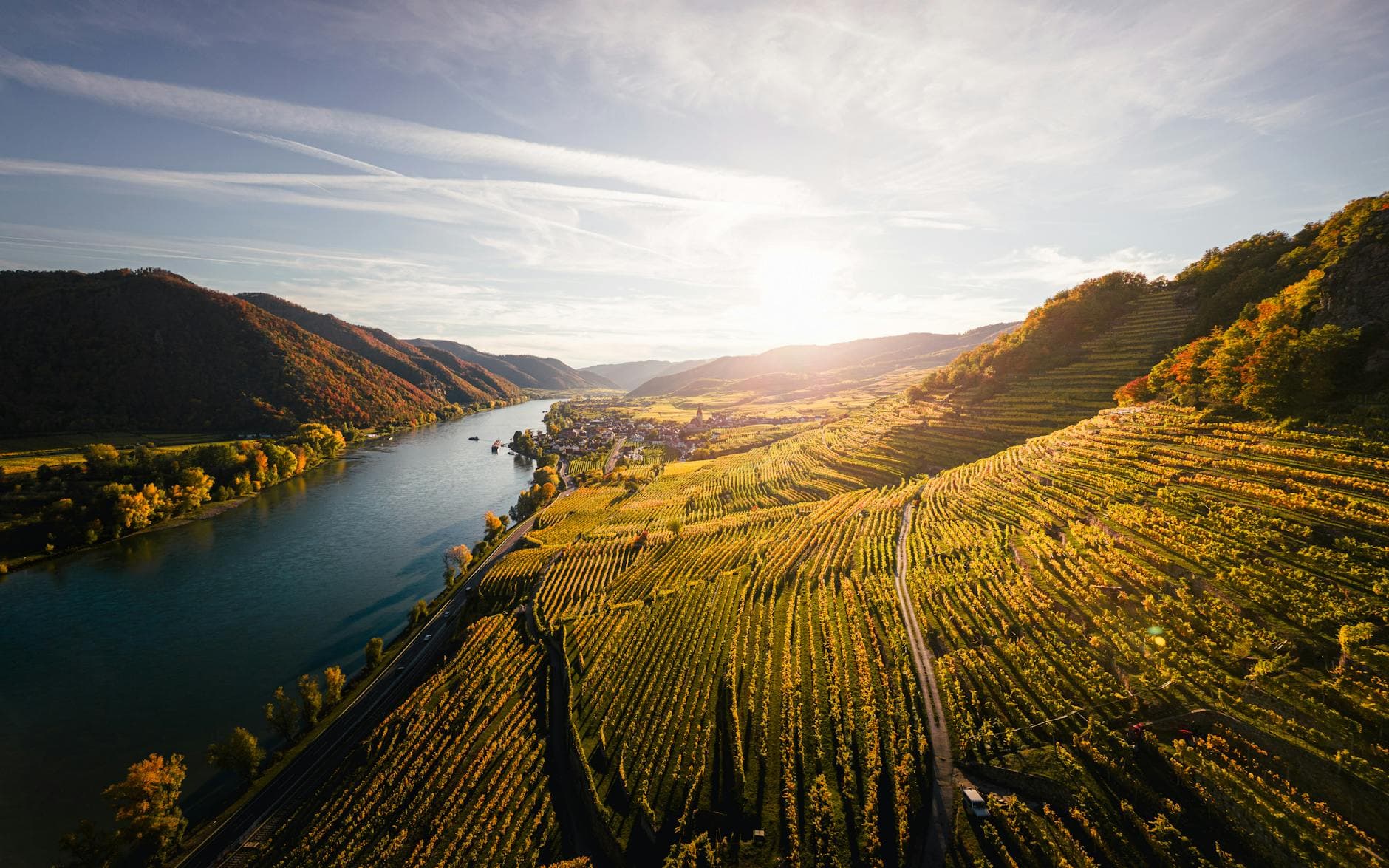
 Photo: Saleh Almawed / Pexels
Where to Stay in Wachau Valley Wine Country: Complete 2026 Guide
Find the best places to stay in Austria's Wachau Valley for wine lovers. From Dürnstein's blue church tower to Weißenkirchen's Grüner Veltliner cellars, discover where to base your trip to this UNESCO Danube wine region.
Planning a trip to Wachau?
Compare hotels, vineyard B&Bs and rentals across Booking, Airbnb and more in one search.
Austria's Wachau Valley is one of Europe's most concentrated wine landscapes. A 33-kilometre stretch of the Danube between Melk and Krems, inscribed as a UNESCO World Heritage Site, where terraced vineyards carved into granite and gneiss slopes produce some of the finest Grüner Veltliner and Riesling on Earth. Medieval villages press against the riverbank, apricot orchards bloom pink each April, and ruined castles watch over every bend. The wines here are classified by a system found nowhere else: Steinfeder (light), Federspiel (medium), and Smaragd (full-bodied)—named after a local emerald lizard.
What sets the Wachau apart from other wine regions is how tightly everything is woven together. You can walk from your hotel to a world-class producer's cellar door, eat cold cuts and Marillenkuchen (apricot cake) at a Heuriger wine tavern run by the vintner's family, and watch the sun drop behind terraces that have been farmed since the ninth century—all within a single afternoon. The region is small enough to explore without a car, yet deep enough in winemaking tradition to reward a week-long stay.
Best Areas to Stay in Wachau Valley at a Glance:
- For postcard views: Dürnstein — blue church tower, castle ruins, cobblestone lanes
- For peace and quiet: Spitz an der Donau — vineyard-ringed village, unhurried pace
- For serious wine: Weißenkirchen — producer heartland, cellar door access
- For convenience: Krems an der Donau — largest town, restaurants, transport hub
- For day-trippers: Melk — abbey town, western gateway, easy Vienna access
Best Areas to Stay for Wine Tasting
Dürnstein
The single most photographed spot in the Wachau. Dürnstein's pale-blue Baroque church tower rises above a huddle of stone houses on a tight bend of the Danube. Above the village sit the ruins of the castle where Richard the Lionheart was imprisoned in 1192. It is tiny—fewer than 900 residents—and in summer it fills with day visitors, but by evening the tour buses leave and the village belongs to overnight guests.
Why wine lovers choose Dürnstein:
- Walking distance to Domäne Wachau's cellar shop
- Evening Heuriger dining after day-trippers depart
- River promenade with direct vineyard trail access
- Some of Austria's most photographed wine scenery
- Premium boutique hotels with Danube-facing terraces
Price range: €120–350/night
Best for: Romance, photography, first-time Wachau visitors
Wine access: Domäne Wachau's flagship shop is in town. Several small producers run seasonal Heurigen. The Dürnsteiner Kellerberg vineyard (single-site Riesling) is a short walk uphill.
Trade-off: The smallest base. Limited restaurants (3–4 options). Day-trip crowds from 10am–4pm in peak season. Book well ahead for summer.
Where to stay: Hotel Schloss Dürnstein (castle hotel with its own wine cellar tastings) and Gartenhotel & Weingut Pfeffel (a working winery with its own vineyard-view spa) are two named options in the village.
Spitz an der Donau
Quieter and less manicured than Dürnstein, Spitz sits at the foot of the Tausendeimerberg—the "Thousand Bucket Hill"—a vineyard so productive it was said to yield a thousand buckets of wine in a good year. The village has a relaxed, working-wine-town feel, with stone farmhouses, a late-Gothic church, and unobstructed river views from the waterfront.
Why wine lovers choose Spitz:
- Tausendeimerberg vineyard on the doorstep
- Quieter atmosphere, fewer tour groups
- Direct Danube cycling path access
- Several family-run Weingut guesthouses
- Ruin Hinterhaus castle for sunset walks
Price range: €80–220/night
Best for: Cyclists, hikers, wine lovers who prefer calm over charm
Wine access: Franz Hirtzberger's estate is based here. Multiple small growers sell direct from cellar doors. Heurigen open spring through autumn.
Trade-off: Fewer restaurants and shops than Krems. No train station—bus or car needed.
Where to stay: Boutiquehotel WEINSPITZ Wachau (adults-only, in the middle of the vineyards) and STIERSCHNEIDER'S Weinhotel Wachau are two named options here.
Weißenkirchen in der Wachau
If the Wachau has a beating heart for serious wine, it is Weißenkirchen. This is where many of the region's top producers are concentrated. The village is larger than Dürnstein but still small, with a fortified church, the Wachaumuseum (housed in a Renaissance Teisenhoferhof), and terraced vineyards climbing steeply behind the main street.
Why wine lovers choose Weißenkirchen:
- Highest density of acclaimed producers in the valley
- Home to Prandtauerhof, Alzinger, and Rudi Pichler
- Fortified church and Wachaumuseum worth visiting
- Authentic working wine village—not a tourist set piece
- Central Wachau location for exploring in both directions
Price range: €90–250/night
Best for: Dedicated wine enthusiasts, repeat Wachau visitors, those who want producer access over scenery
Wine access: Outstanding. Nikolaihof (Austria's oldest biodynamic estate) is in neighbouring Mautern, a short drive. F.X. Pichler is nearby in Oberloiben. Knoll, Prager, and several others within walking or cycling distance.
Trade-off: Less river-frontage drama than Dürnstein. Fewer high-end hotel options—mostly guesthouses and Weingut stays.
Where to stay: Renaissancehotel Raffelsberger Hof (built in 1574 as a shipmaster's house, in the historic village centre) and Donauhof (a small, family-run hotel by the river) are two named options.
Krems an der Donau
The Wachau's eastern gateway and its only proper town. Krems has a university, a pedestrianised old town, a contemporary art museum (Kunsthalle Krems), and far more restaurants, cafés, and shops than anywhere else in the valley. It is also a major transport hub: direct trains to Vienna (75 minutes), bus connections to every village, and the start point for Danube cycling routes.
Why wine lovers choose Krems:
- Widest restaurant and nightlife selection
- Direct train service to Vienna Hauptbahnhof
- Winzer Krems cooperative cellar and shop in town
- Art, culture, and non-wine activities for mixed groups
- Year-round economy—not seasonal like smaller villages
Price range: €80–280/night
Best for: Mixed-interest groups, urban comfort lovers, anyone arriving by public transport
Wine access: Stadt Krems and Winzer Krems both have tasting rooms. The Kremstal DAC wine area (technically adjacent to Wachau) has excellent Grüner Veltliner producers. Easy day trips into the Wachau proper by bike or bus.
Trade-off: Less village atmosphere. You are on the edge of the Wachau rather than inside it. Traffic noise on the main road.
Where to stay: Steigenberger Hotel & Spa Krems and LOISIUM Wine & Spa Resort Langenlois (a short drive away, wine-themed spa) are two named options for an urban base.
Melk
Melk is the western gateway, dominated by its enormous Benedictine abbey perched above the Danube—one of Austria's most visited baroque buildings. The abbey has produced wine for centuries, and the town below is a practical, well-connected base. Vienna is 90 minutes by car or train.
Why wine lovers choose Melk:
- Stift Melk abbey with historic wine cellars
- Western starting point for Danube cycling path
- Good train connections to Vienna and Linz
- Affordable accommodation compared to in-valley options
- Danube river cruise boarding point
Price range: €70–200/night
Best for: Day-trippers from Vienna, abbey and history enthusiasts, budget-conscious travellers
Wine access: Limited compared to mid-valley villages. The abbey has a wine shop. Wachau's top producers are 20–30 minutes east by car or bike.
Trade-off: You are outside the vineyard heartland. Wine access requires transport. The town empties after abbey visiting hours.
Where to stay: Hotel Restaurant zur Post (in the centre, direct views of Melk Abbey) and Hotel zum Schwarzen Bären (family-owned since 1908, with a spa) are two named options.
Types of Accommodation
Weingut & Heuriger Stays (€70–180/night)
Staying at a working winery is the most authentic Wachau experience. Many producers rent guest rooms above their cellars or in converted farmhouses. A Heuriger is a seasonal wine tavern where the grower serves their own wine with cold platters—some also offer overnight accommodation.
What to expect:
- Rooms in or beside a working winery
- Tastings with the family who made the wine
- Cold buffet Heuriger meals (bread, cheese, Schmalz, Verhackert, smoked meats)
- Breakfast with homemade apricot jam
- Unpretentious, personal atmosphere
Best for: Wine-focused travellers, those comfortable with basic amenities, German speakers (though English is increasingly common)
Boutique Hotels (€150–400/night)
A handful of high-end boutique properties have opened in the valley over the past decade, several with Danube-view terraces, wine-focused dining, and curated tasting programmes. Dürnstein and Krems have the most options.
What to expect:
- Designer rooms, often in historic stone buildings
- Restaurant with regional cuisine and Wachau wine lists
- Concierge-arranged vineyard tours
- Spa or wellness facilities at top properties
- River or vineyard views
Best for: Special occasions, couples, comfort-first travellers
Gasthof & Guesthouses (€60–130/night)
Traditional Austrian inns (Gasthöfe) and family-run Pensionen dot every Wachau village. Rooms are clean and simple, breakfasts are generous, and the hosts know the valley inside out.
What to expect:
- Simple, well-maintained rooms
- Full Austrian breakfast included
- Home-cooked dinners available at Gasthöfe
- Local knowledge and recommendations
- Central village locations
Best for: Budget travellers, hikers, cyclists, families
Danube River Cruises
The Wachau is one of Europe's premier river cruise stretches. Several operators run multi-day sailings between Passau and Budapest that pass through the valley. Shorter day cruises between Melk and Krems are also popular.
What to expect:
- Scenic cruising through the entire valley
- Onboard wine tastings featuring Austrian producers
- Shore excursions to Dürnstein and Melk Abbey
- All-inclusive dining and accommodation
- Limited independent exploration time
Best for: Those combining Wachau with a broader Danube itinerary, travellers who prefer structured experiences
When to Visit Wachau Valley
Apricot Blossom Season (Late March–April)
The valley's 100,000 apricot trees bloom in waves of white and pink. Producers begin opening Heurigen for the season. Weather is mild but unpredictable.
Peak Season (May–September)
Warm days, green vineyards, full Heuriger and restaurant schedules. July and August are hottest and busiest. September brings the first signs of harvest.
Harvest Season (October)
Grüner Veltliner picks begin mid-September; Riesling and Smaragd-level fruit hangs into late October. Vineyards turn gold and amber. Heurigen serve Sturm (partially fermented grape juice). One of the best times to visit.
Quiet Season (November–March)
Most Heurigen close. Hotels offer lower rates. Christmas markets appear in Krems and nearby towns. The valley is atmospheric but limited in dining options.
| Month | Weather | Crowds | Prices | Highlights |
|---|---|---|---|---|
| Jan–Feb | Cold, 0–5°C | Very low | Lowest | Quiet, off-season rates |
| Mar–Apr | Mild, 8–16°C | Low–Medium | Medium | Apricot blossom, Heurigen reopen |
| May–Jun | Warm, 18–25°C | Medium–High | High | Green vineyards, cycling weather |
| Jul–Aug | Hot, 25–32°C | High | Highest | Full schedules, river cruises peak |
| Sep–Oct | Warm, 15–24°C | Medium–High | High | Harvest, Sturm, autumn colours |
| Nov–Dec | Cool, 2–8°C | Low | Medium | Christmas markets in Krems |
Insider Tips for Wachau Valley Wine Travel
- Learn the Wachau wine classification — Steinfeder (up to 11% ABV, light and fresh), Federspiel (11.5–12.5%, the everyday sweet spot), and Smaragd (12.5%+, full-bodied and age-worthy). These terms are unique to the Wachau and protected by the Vinea Wachau growers' association. Start with Federspiel to get your bearings.
- Know the top producers — Domäne Wachau (large cooperative, consistent quality), F.X. Pichler (iconic, allocations sell out), Franz Hirtzberger (Spitz, precise Smaragd wines), Emmerich Knoll (traditional, outstanding Riesling), Nikolaihof (Austria's oldest biodynamic estate, in Mautern), and Prager (Weißenkirchen, excellent single-vineyard bottlings). Most accept visitors but call ahead for F.X. Pichler.
- Cycle the Danube path — The Wachau section of the EuroVelo 6 / Donauradweg is flat, paved, and runs right through the vineyards. Rent bikes in Krems or Melk. The full Krems-to-Melk stretch takes 2–3 hours at a relaxed pace, with Heuriger stops stretching that to a full day.
- Heuriger etiquette — You seat yourself. Order wine at the counter (by the Achtel, an eighth-litre glass, or Viertel, a quarter-litre). Food is self-service from the cold buffet. Pay when you leave. A green bush or wreath (Buschen) hanging outside the door means the Heuriger is open. No reservations needed or expected.
- Day trip from Vienna is easy but staying is better — Krems is 75 minutes from Wien Hauptbahnhof by ÖBB train. A day trip works for a quick visit, but the valley rewards at least two nights. Mornings before the tour buses and evenings after they leave are when the Wachau is at its best.
- Try Marille everything — Wachau apricots (Marillen) are protected by EU geographical indication status. Marillenbrand (apricot brandy), Marillenknödel (apricot dumplings), Marillenmarmelade, and Marillenkuchen appear on every menu in season (June–July). The brandy makes an excellent souvenir.
- Book Smaragd wines to take home — Top Smaragd bottlings from great producers are difficult to find outside Austria and often sell out at the estate. If you taste something exceptional, buy it there. Shipping within the EU is straightforward; most estates will arrange it.
- Cross the river to Mautern and Göttweig — The south bank of the Danube is often overlooked. Mautern has Nikolaihof and excellent restaurants. Stift Göttweig (Göttweig Abbey) sits on a hill above the river with panoramic views and its own wine production. A short ferry or bridge crossing opens up a different perspective on the valley.
Frequently Asked Questions
How do I get to the Wachau Valley?
Take a direct REX train from Vienna's Franz-Josefs-Bahnhof to Krems, about an hour. From Krems, local trains, buses, and river boats reach Dürnstein and Weißenkirchen further along the valley.
What is the best time to visit the Wachau?
Apricot blossom season (late March-April) shows the valley's 100,000 apricot trees in bloom; peak season (May-September) brings full Heuriger schedules and river cruises.
Do I need a car in the Wachau?
No — the Wachau is one of the few wine regions genuinely workable by train, boat, or bike along the Danube cycle path.
Should I day-trip from Vienna or stay overnight?
A day trip is possible — Krems is roughly 75 minutes from Wien Hauptbahnhof — but staying overnight lets you catch Heuriger evenings and avoid the tour-bus crowds at Melk Abbey and Dürnstein.
What wines is the Wachau known for?
Grüner Veltliner and Riesling, classified by ripeness into three tiers: Steinfeder, Federspiel, and Smaragd.
What should I budget for a Wachau wine trip?
Boutique hotels run €150-400/night. A casual Heuriger dinner with wine by the Achtel costs €20-40 per person.
How does the Wachau compare to other Austrian wine regions?
It's more compact and UNESCO-protected than Burgenland or Styria, with dramatic terraced vineyards along the Danube. Neighbouring Kamptal and Kremstal share a similar Grüner Veltliner style at lower prices.
Book Your Wachau Valley Wine Country Stay
Ready to experience Austria's finest wine valley? Compare wine country stays on Stay22—from Dürnstein boutique hotels to Weißenkirchen Weingut guesthouses. Stay22 compares prices across Booking, Airbnb, Hotels.com and more in one search.
Compare Wachau Valley stays on Stay22 →
The Wachau delivers what few wine regions can: world-class wine, UNESCO-protected scenery, and a food culture built around the harvest calendar—all packed into a valley you can cycle end to end before lunch.
More Wine Travel Guides
- Where to Stay in Rhine Valley
- Where to Stay in Burgundy
- Where to Stay in Tuscany
- Where to Stay in Douro Valley
Word Count: ~1,650
Last Updated: March 2026
Author: WineTravelGuides Editorial Team


Ready to visit Wachau?
Build your personalised day-by-day itinerary — choose your travel style and trip length, get accommodation and tour picks per day, and email it to yourself to take along.
Upcoming Wine Festivals in Austria
See all festivalsHidden Gems Nearby
Discover more hidden gemsWeingut Nikolaihof
WTG PickWachau, Austria
Austria's first biodynamic winery on Roman foundations — producing Rieslings that age for decades in a cellar complex dating back 2,000 years.
Riesling · Grüner Veltliner
Weingut Rudi Pichler
WTG PickWachau, Austria
One of Wachau's most minerally precise Smaragd producers — tiny output, personal cellar visits, and wines that rarely leave Austria.
Gruner Veltliner · Riesling
Book Your Wachau Wine Country Stay
Compare hotels, vineyard B&Bs and rentals across Booking, Airbnb and more in one search.
Compare stays near the vineyardsStay22
Plan Your Where to Stay in Wachau Valley Wine Country: Complete 2026 Guide Trip
Estimate your Where to Stay in Wachau Valley Wine Country: Complete 2026 Guide trip cost
Budget calculator with accommodation, food, wine, and transport estimates.
Try itCompare Where to Stay in Wachau Valley Wine Country: Complete 2026 Guide with other regions
Side-by-side comparison of cost, climate, wine styles, and more.
Try itWhen to visit Where to Stay in Wachau Valley Wine Country: Complete 2026 Guide
Harvest dates, peak season, and the best months for wine travel.
Try itThis page contains affiliate links. We may earn a commission at no extra cost to you.