Best Wineries in Italy: Tuscany, Piedmont, Veneto & More
Italy's best wineries across Tuscany, Piedmont, Veneto, Sicily, and beyond. Where to taste Barolo, Brunello, Amarone, and Prosecco at the source — with planning tips for each region.
Best Wineries in Italy: Tuscany, Piedmont, Veneto & More
Italy produces more wine than any other country on Earth. In a typical year it accounts for roughly 15–20% of global wine output, drawing grapes from 350,000 vineyards spread across all 20 of its administrative regions. From the snow-edged Alps in the north to the volcanic slopes of Sicily in the south, almost every patch of Italian soil has been planted at some point, and the country's 350-plus native grape varieties — more than any other nation — mean that no two regions taste remotely alike.
That diversity is precisely why visiting Italian wineries is such a different proposition from touring Napa Valley or Bordeaux. There is no single Italian wine identity. Tuscany and Piedmont alone could occupy a serious wine traveller for a week each. Add Veneto, Sicily, Campania, and Friuli-Venezia Giulia to the list and you have enough material for years of trips. The difficulty is not finding good wineries — it is deciding where to go first.
This guide is organised by region. It covers the four regions that make the most compelling cases for dedicated winery visits — Tuscany, Piedmont, Veneto, and Sicily — followed by a briefer look at four other regions worth knowing. For each major region you will find real producers, what makes them worth the detour, and practical notes on visiting. The planning sections at the end address logistics, booking culture, and the question of when to go.
For help structuring your trip from scratch, see our how to plan a wine tour guide before reading on.
Italy's Wine Regions at a Glance
The table below maps Italy's major wine regions to their key wines and the type of traveller each suits best. It is not exhaustive — Italy has 77 DOC and 77 DOCG appellations — but it covers the regions most relevant to planning an actual trip.
| Region | Key Wines | Style | Best For |
|---|---|---|---|
| **Tuscany** | Chianti Classico, Brunello di Montalcino, Super Tuscans, Vino Nobile | Structured red Sangiovese; some exceptional Merlot/Cabernet blends | First-time Italy visitors; countryside touring; agriturismo stays |
| **Piedmont** | Barolo, Barbaresco, Barbera d'Alba, Moscato d'Asti | Age-worthy Nebbiolo; food-driven reds; aromatic whites | Serious wine collectors; truffle and pasta food pairing |
| **Veneto** | Amarone, Valpolicella, Soave, Prosecco, Lugana | Full-bodied dried-grape reds; crisp whites; sparkling | Mixed-itinerary travellers combining wine with Verona/Venice |
| **Sicily** | Nero d'Avola, Etna Rosso/Bianco, Marsala, Cerasuolo di Vittoria | High-altitude volcanic whites and reds; ancient indigenous varieties | Off-the-beaten-track travellers; volcanic terroir enthusiasts |
| **Friuli-Venezia Giulia** | Ribolla Gialla, Friulano, skin-contact whites | Complex, textural whites; some of Italy's best orange wines | Natural wine enthusiasts; Austrian/Slovenian border food culture |
| **Campania** | Greco di Tufo, Fiano di Avellino, Taurasi | Ancient varieties; mineral-driven whites; structured Aglianico reds | Southern Italy itineraries; Greek heritage wine history |
| **Abruzzo** | Montepulciano d'Abruzzo, Trebbiano d'Abruzzo | Rustic, value-driven reds; increasingly serious whites | Budget-conscious travellers; Adriatic coastal trips |
| **Puglia** | Primitivo di Manduria, Salice Salentino, Negroamaro | Dense, sun-driven reds; warm and generous style | Winter sun visitors; heel-of-Italy road trips |
For a broader context on how Italian wines fit into the global picture, our Old World vs New World wine guide explains the key differences in style and winemaking philosophy.
Tuscany — Home of Chianti, Brunello, and Super Tuscans
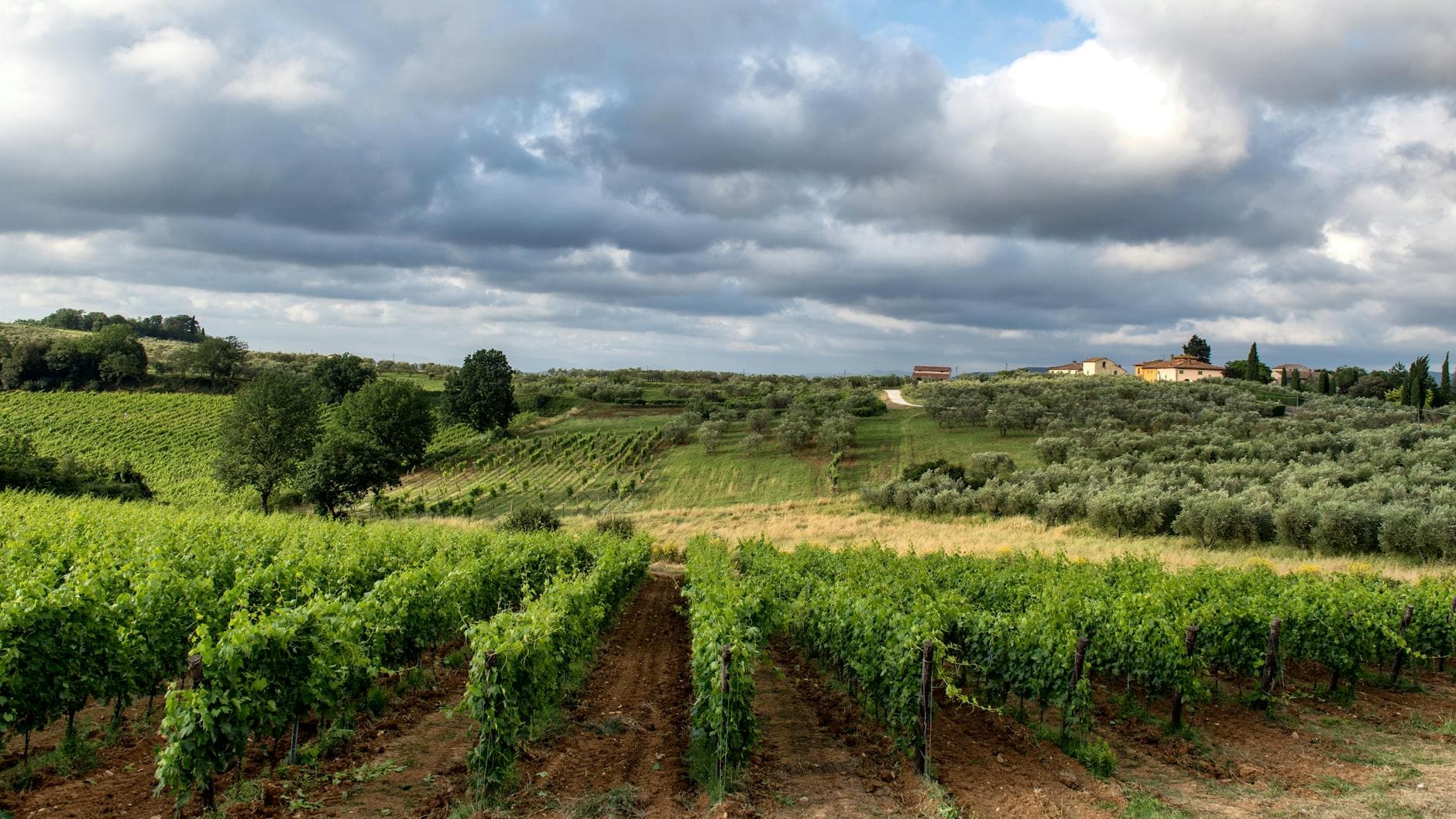
Tuscany is where most wine travellers begin, and with good reason. The region packages remarkable wine quality with accessible infrastructure: well-signed driving routes, a mature agriturismo network, and estates that have been welcoming visitors for decades. The Chianti Classico zone between Florence and Siena is the most visited wine corridor, but Montalcino in the south produces Brunello di Montalcino — one of Italy's longest-lived reds — and the coastal strip of Bolgheri gave rise to the Super Tuscans, the blends of Cabernet Sauvignon, Merlot, and Syrah that reshaped how Italy was perceived internationally from the 1970s onwards.
Sangiovese is the backbone of most Tuscan reds, but the variety expresses itself very differently depending on altitude, soil, and producer philosophy. A Chianti Classico Gran Selezione from 500-metre vineyards in Gaiole will taste nothing like a Morellino di Scansano from the Maremma coast. Understanding those distinctions is part of what makes spending time here so rewarding.
The practical realities of visiting Tuscan wineries — always book ahead, respect the lunch break, plan no more than two or three estates per day — apply across the board. Tuscan roads are narrow and frequently unpaved near the estates; GPS estimates are unreliable. Build in extra time.
For a full list of recommended estates, tasting fees, booking contacts, and what to order at each, see our complete Tuscany wineries guide. It covers 12 producers across Chianti Classico, Montalcino, Bolgheri, Montepulciano, and the Maremma.
Piedmont — Italy's Burgundy
If Tuscany is where most people start, Piedmont is where serious wine travellers end up. The region in the northwest corner of Italy, pressed between the Alps and the Apennines, produces Barolo and Barbaresco — two of the world's great age-worthy reds — from the Nebbiolo grape. Like Burgundy's Pinot Noir, Nebbiolo is difficult to grow, thinly skinned, and almost aggressively tannic in youth, but it evolves in bottle over 10 to 30 years into something of uncommon depth and complexity.
The Barolo zone covers 11 communes around the town of Alba in the Langhe hills. Barbaresco, smaller and often described as more elegant, sits to the northeast. The soil differences between villages — Serralunga's compact Helvetian limestone vs Barolo town's older Tortonian deposits — create wine personalities distinct enough that locals can argue passionately about them over lunch, which in Piedmont means white truffles, tajarin pasta, and Barbera d'Alba.

Piedmont is also less tourist-saturated than Tuscany outside of harvest season. The roads are better. The cooking is extraordinary. And the combination of Barolo, Barbaresco, Barbera, Dolcetto, and Moscato d'Asti means you rarely need to drink the same grape twice.
Gaja (Barbaresco)
Angelo Gaja is the figure most responsible for putting Piedmont on the international wine map. His controversial decision in the early 1990s to declassify some of his single-vineyard Barbarescos — Sori Tildin, Costa Russi, Sori San Lorenzo — to Langhe Nebbiolo DOC (because they contained small amounts of Cabernet Sauvignon) caused outrage locally and proved entirely irrelevant to the market, which continued to treat them as among Italy's most prestigious bottles.
Today, Gaja produces wines from both Piedmont and Tuscany (where they own the Pieve Santa Restituta estate in Montalcino). Tastings at the Barbaresco winery are not open to the general public in the traditional walk-in sense — Gaja operates by appointment only, primarily for trade and serious collectors. If you can arrange access through a wine tour operator or a trusted intermediary, the tasting library covers multiple vintages. Plan well ahead; this is not a spontaneous stop.
Known for: Barbaresco (single-vineyard), Barolo (from the Sperss and Dagromis vineyards), Brunello di Montalcino (via Ca' Marcanda)
Giacomo Conterno (Barolo)
For many collectors, Conterno's Monfortino Riserva is the single greatest wine made in Piedmont — and one of the strongest cases for the long maceration, large-barrel, traditionalist school of winemaking that the family has practised for over a century. Giovanni Conterno released his last vintage in 2004; his son Roberto now runs the estate, maintaining the unhurried approach that produces wines that need a decade in bottle before they begin to open.
Visits are by appointment, arranged through the estate directly. The tasting room is unfussy. Roberto Conterno is not given to theatrics. What you get is the wine itself, which is argument enough.
Known for: Barolo Monfortino Riserva, Barolo Francia, Barbera d'Alba Cascina Francia
Bruno Giacosa (Barbaresco and Barolo)
Giacosa spent his career making wine from purchased fruit at a time when this was considered the highest expression of the Piedmontese broker tradition. He had an unmatched eye for selecting individual plots — Rabajà in Barbaresco, Falletto in Serralunga d'Alba for Barolo — and the wines he produced under his own label are considered among the finest the region has generated in the last 50 years.
Giacosa died in 2017. The estate continues under his daughter Bruna, with production centred on the Falletto vineyard in Serralunga and selected Barbaresco plots. The white and red label system Giacosa used (red label indicates a superior vintage that warranted Riserva designation) remains in place.
Visits are by appointment through the estate in Neive. The cellar tour and tasting experience is focused and professional.
Known for: Barolo Falletto (red and white label), Barbaresco Rabajà and Santo Stefano, Barbera d'Alba
Vietti (Barolo)
The Vietti family traces its presence in Castiglione Falletto back to the late 19th century, though the estate in its modern form was shaped by Alfredo Currado and his son-in-law Mario Cordero during the mid-20th century. Today the estate is known for a comprehensive portfolio of single-vineyard Barolos — Rocche, Brunate, Lazzarito, Ravera, Villero, Castiglione — that function almost as a classroom in the different communes and soils of the DOCG.
Vietti also produces one of the reference-point Barbera d'Astis (Scarrone Vigna Vecchia) and some of the best Arneis in Piedmont. The estate is more visitor-friendly than most at this quality level, with tastings available by appointment at their winery in Castiglione Falletto.
Known for: Single-vineyard Barolos, Barbera d'Alba, Barbera d'Asti Scarrone Vigna Vecchia, Arneis
Elvio Cogno (Novello)
Elvio Cogno represents a different Barolo experience: a smaller estate, less internationally famous, producing wines of genuine quality from the Novello commune — an area increasingly recognised for the Ravera cru. The late Elvio Cogno's son-in-law Walter Fissore runs the estate with his wife Nadia, and their Barolo Ravera (particularly the Bricco Pernice single-vineyard selection) is a compelling argument for the Novello terroir.
The estate is more accessible than the bigger names, with a proper tasting room and tours available by appointment. Tasting fees are typically in the EUR 25–45 range depending on the selection.
Known for: Barolo Ravera, Barolo Bricco Pernice, Barbera d'Alba
Veneto — Amarone, Soave, and Prosecco Country
The Veneto in northeast Italy is the country's largest wine-producing region by volume, which is partly a function of the enormous quantities of Pinot Grigio and Prosecco produced here for international markets. But behind that industrial-scale output sits a layer of genuinely serious winemaking — particularly in Valpolicella, where the dried-grape Amarone and its lighter counterpart Ripasso occupy their own category in the Italian wine hierarchy.
The region also offers practical advantages for travellers: Verona is a convenient base with its own medieval core and the Roman Arena, the drive from Verona into the Valpolicella hills takes under 30 minutes, and the Veneto's gentler topography makes day-trip winery visits more straightforward than in Piedmont.
Soave, to the east of Verona, has spent decades recovering its reputation after the mass-production era of the 1970s, and estates like Pieropan and Inama now produce single-vineyard Soave Classico that competes seriously with fine white Burgundy. To the north, Prosecco DOC and Conegliano Valdobbiadene DOCG (the premium zone) generate a different style of visit — lighter, more casual, suited to afternoon terraces overlooking the UNESCO-listed hillside vineyards.
Allegrini (Valpolicella and Amarone)
Allegrini is one of the estates most responsible for restoring the reputation of Valpolicella as a wine region worth taking seriously. The family's La Poja — a single-vineyard Corvina in the style that preceded Amarone declassification — was one of the early demonstrations that Valpolicella's indigenous grapes could produce world-class red wine without the appassimento drying process.
Their Amarone della Valpolicella Classico uses the traditional blend of Corvina, Corvinone, Rondinella, and Oseleta, aged in large Slavonian oak. The La Grola single-vineyard Valpolicella Superiore is a more accessible price point that still shows the estate's precision.
Visits to the historic Villa della Torre estate (also owned by Allegrini) are available by appointment and combine a tour of the 16th-century Renaissance villa with tastings.
Known for: Amarone della Valpolicella Classico, La Poja, La Grola
Masi Agricola (Amarone and Ripasso)
Masi has been in the Boscaini family for six generations and has been central to defining Amarone as a category, including the development of the Ripasso technique — referementing standard Valpolicella on the dried grape skins left over from Amarone production. Their Costasera Amarone and Campofiorin Ripasso are two of the most widely distributed Italian wines internationally.
The estate operates a proper visitor centre at the Serego Alighieri estate in Sant'Ambrogio di Valpolicella — a property they manage in partnership with the Alighieri family, descendants of the poet Dante, who has owned land here since 1353. The combination of wine history and literary history makes this one of the more distinctive tasting experiences in the Veneto.
Tastings are available without appointment at the visitor centre; cellar tours and winemaker tastings require booking.
Known for: Amarone Costasera, Campofiorin Ripasso, single-vineyard Amarone Vaio Armaron and Mazzano
Zenato (Soave and Lugana)
Zenato works across two distinct appellations: Soave Classico in the hills east of Verona, and Lugana on the southern shore of Lake Garda. The Lugana DOC, based on the Turbiana grape (locally known as Trebbiano di Lugana), is one of the most underrated white wine zones in northern Italy — mineral, textural, and age-worthy in a way that most people don't expect from an Italian white.
The Zenato family has been producing Lugana since 1960. Their Sergio Zenato Riserva is aged partially in French oak and represents one of the best examples of what the appellation is capable of producing. On the Soave side, the Crespin cru bottling is worth seeking out.
Visits are available at the Lugana estate in Peschiera del Garda by appointment.
Known for: Lugana DOC, Lugana Sergio Zenato Riserva, Soave Classico Crespin
Sicily — Italy's Rising Star
Sicily produces roughly one-sixth of Italy's total wine output, a statistic that until about 20 years ago mostly translated into bulk wine shipped north to add colour and weight to underripe blends from cooler regions. The transformation since then has been dramatic. Investment from mainland producers, a new generation of local winemakers, and growing international recognition of indigenous varieties like Nero d'Avola, Nerello Mascalese, and Carricante have repositioned Sicily as one of Italy's most compelling regions.
The standout story is Mount Etna. The volcano's black basalt soils, extreme altitude (many vineyards sit between 600 and 1,000 metres), and the old Nerello Mascalese vines — some over a century old — produce wines that bear more resemblance to fine Burgundy than to anything else in southern Italy. Etna Rosso has attracted collectors and sommeliers who would previously have ignored Sicily entirely.

Sicily also remains one of the most affordable wine regions in Italy to visit. Tasting fees are generally lower than in Tuscany or Piedmont, driving distances between estates are larger but roads are better than in the north, and Palermo and Catania provide international flight connections.
Planeta (Menfi and Multiple Estates)
Planeta is the Sicilian producer that most directly drove the island's modern reputation. When the family released their first Chardonnay in the mid-1990s, under the guidance of winemaker Carlo Corino and with advice from Giacomo Tachis, it signalled that Sicily could produce internationally competitive white wine. Their Nero d'Avola (Santa Cecilia) made a similar argument for red wine.
What distinguishes Planeta today is the breadth of their estate holdings. They manage six properties across Sicily — Menfi on the southwest coast, Vittoria for Cerasuolo, Noto for late-harvest Moscato, Chardonnay at Sambuca, and two Etna estates — covering essentially every major Sicilian appellation. Each estate reflects its terroir rather than a single house style.
Visits are available at multiple Planeta estates with advance booking. The Menfi winery is the most accessible starting point; the Etna estate at Castiglione di Sicilia offers the most dramatic setting.
Known for: Santa Cecilia Nero d'Avola, Cometa Fiano, Etna Rosso and Bianco, Cerasuolo di Vittoria
Donnafugata (Marsala and Etna)
Donnafugata began in Marsala in western Sicily, where the Rallo family has been producing wine since 1851. Their modern reputation rests largely on Ben Ryé Passito di Pantelleria — a dried-grape dessert wine from the island of Pantelleria, made from Zibibbo grapes, that is consistently one of Italy's best sweet wines — and on their Etna range, where their Contrada Marchesa vineyard in the northern flank of the volcano produces structured, age-worthy Nerello Mascalese.
The Marsala estate offers cellar tours and tastings at their historic baglio in Marsala town. The Etna estate at Randazzo is available for visits by appointment.
Known for: Ben Ryé Passito di Pantelleria, Etna Rosso Contrada Marchesa, Tancredi (Nero d'Avola/Cabernet blend)
Benanti (Etna Rosso)
Giuseppe Benanti was among the first to recognise what the Etna terroir could produce, beginning his project in the late 1980s at a time when the volcano's wines had no international profile. His Pietramarina white (Carricante from the Milo vineyards on the eastern flank) and his Nerello Mascalese-based reds from the northern contrade remain defining expressions of the appellation.
Benanti tends to operate on a smaller, more appointment-driven basis than Planeta or Donnafugata, but visits can be arranged and provide a more intimate window into the volcanic terroir. The cellar sits at altitude with Etna directly above; on a clear day the combination of the mountain and the surrounding lava field landscape is extraordinary.
Known for: Pietramarina Etna Bianco Superiore, Serra della Contessa Etna Rosso, Rovittello Etna Rosso
Other Essential Italian Wine Regions
Friuli-Venezia Giulia
In the far northeast, sharing borders with Austria and Slovenia, Friuli-Venezia Giulia produces whites that are difficult to categorise by international standards. The region's indigenous varieties — Friulano (the old Tocai), Ribolla Gialla, Malvasia Istriana — are cultivated by producers ranging from straightforward to deeply experimental. Josko Gravner and Stanislao Radikon built international reputations from the Oslavia area by returning to ancient amber/orange wine methods: long skin maceration of white grapes, often in terracotta amphorae. The resulting wines are textural, oxidative, and unlike almost anything else produced in Italy.
For travellers interested in natural wine and Italy's deep history of skin-contact winemaking, Friuli is a compelling detour, particularly combined with a crossing into Slovenia's Brda region across the border.
Campania
Southern Italy's underrated wine region, Campania centres on ancient Greek varieties — Greco di Tufo, Fiano di Avellino — that produce some of the most mineral, age-worthy dry whites in the country. The red side is dominated by Aglianico, a variety with deep tannins and a structure that many compare to Nebbiolo in its need for extended cellaring.
The Feudi di San Gregorio estate near Avellino is the most visitor-accessible producer in the region and offers a modern winery experience with a restaurant. For a more traditional approach, Mastroberardino in Atripalda has been producing Taurasi and Fiano for over a century and offers cellar tours and tastings by appointment.
Campania suits travellers combining wine with Naples, the Amalfi Coast, and Pompeii, rather than dedicated wine-only trips.
Abruzzo
Between the Apennines and the Adriatic, Abruzzo is one of Italy's best-value wine regions. Montepulciano d'Abruzzo (not to be confused with Tuscany's Vino Nobile di Montepulciano, which uses Sangiovese) is a rustic, food-friendly red that overdelivers at its price point. Valentini's single-vineyard version is considered one of Italy's great wines. Trebbiano d'Abruzzo, in skilled hands, produces structured whites of unexpected depth.
Abruzzo does not have the winery-visit infrastructure of Tuscany or Piedmont, but it rewards travellers who make the effort — in combination with the Adriatic coast and the Gran Sasso national park.
Puglia
Italy's heel, long a source of bulk wine, now produces increasingly focused Primitivo di Manduria and Negroamaro-based reds that benefit from the intense southern sun and often old-vine material. The Salice Salentino zone near Lecce is a practical base for winery visits in the south; Gianfranco Fino's single-vineyard Primitivo (Es) brought the appellation serious critical attention in the 2010s.
Puglia's combination of wine, whitewashed trulli architecture, olive groves, and some of Italy's best seafood makes it a compelling off-season destination — October through April is more manageable than the summer heat.
How to Plan an Italian Wine Tour
Italy does not function as a single wine destination. The practical reality is that you choose one or two regions per trip and explore those properly, rather than attempting to cover the whole country in a single itinerary.
Getting around: A car is essential in most wine regions. The Chianti Classico zone, the Langhe hills around Alba, and the Valpolicella hills outside Verona are all best navigated by car. Trains connect the major cities (Florence, Turin, Verona, Palermo), but the final leg to most wineries requires a car. Car hire from major city airports is straightforward. If you are planning to drink, book a driver for the day or designate a non-drinking navigator — Italian traffic police are active during harvest season.

Train-accessible bases: Florence for Tuscany, Turin or Alba for Piedmont, Verona for Veneto, Palermo or Catania for Sicily. All have direct train or flight connections from major European hubs.
Hiring a guide: For first-time visitors to Piedmont in particular, a local guide or private tour organiser adds significant value — they handle bookings, know which estates are worth prioritising, and often have access to visits that are not available through direct booking. Several Barolo-focused guides operate out of Alba.
Trip length by region: Allow a minimum of three days for Tuscany (Chianti Classico alone warrants two), two to three days for the Langhe in Piedmont, two days for Valpolicella and the Veneto, and three days for Sicily if combining the southwest and Etna. For a comprehensive tour of Italy's wine regions, expect ten days as a minimum.
Italian Winery Visit Tips
Enoteca vs estate visit: An enoteca is a wine shop or wine bar, sometimes operated by a consortium (as in Montalcino's Fortezza or the Enoteca Italiana in Siena), where you can taste across multiple producers in one place. This is useful for orientation before committing to individual estate visits. Estate visits are more personal and allow you to understand a single producer's philosophy in depth. Both are valuable; start with an enoteca if you are new to a region.
Reservation culture: Unlike New World wine regions where walk-ins are often welcomed, Italian estates — particularly in Piedmont and among better Tuscan producers — expect advance reservations. Email in advance, use the estate's booking form, or go through a local wine tour operator. Showing up without a booking at a small family estate is considered discourteous and will often result in a polite refusal.
Agriturismo stays: The agriturismo system — farm stays on working agricultural properties, many of which are wine estates — is one of Italy's best hospitality structures for wine travellers. Staying on an estate eliminates driving concerns, often includes meals with the estate's wine, and provides access to the winemaker over dinner in a way that a day-visit cannot. Prices are typically EUR 100–200 per night including breakfast; some include dinner. Book months ahead for harvest season (late August through October).
Language: Most wineries with international ambitions have English-speaking staff. Smaller family estates may not. A few phrases in Italian — Posso prenotare una degustazione? (Can I book a tasting?), Quant'è la degustazione? (How much is the tasting?) — are appreciated and often unlock a warmer reception.
Buying and shipping: Estate prices are substantially lower than retail in most export markets. Many estates can arrange shipping, though Italian wine shipping regulations vary by destination country. An alternative is to use a specialist wine shipper in major Italian cities — Florence, Milan, and Verona all have operators experienced in exporting. Check customs allowances for your home country before purchasing in volume.
For guidance on what to expect in a tasting room setting, our wine tasting etiquette guide covers the conventions that apply across regions and producers.
When to Visit Italy for Wine
Harvest season (late August to mid-October): The most atmospheric time to visit. Vineyards are in activity, cellar aromas are strongest, and many estates offer harvest experiences — picking alongside the crew, followed by lunch. The downside is that the best estates are fully booked months in advance and popular towns like Montalcino and Barolo become crowded. Book accommodation by June for September visits.
Spring (April to June): Underrated. The vines are just leafing out, the landscapes are green, and tourist numbers are lower than summer. Winery visits are more relaxed. Weather is mild across most regions. Piedmont in particular is excellent in April — white truffle season begins in October but spring mushrooms (morel, porcini) provide equally good table context for Nebbiolo.

Summer (July and August): Hot across all of southern Italy and increasingly challenging in Tuscany and the Veneto. Many smaller estates close for the Ferragosto holiday (mid-August). If you visit in high summer, book ahead, start winery visits early (9–11am before the midday heat), and focus on north-facing or higher-altitude estates where temperatures are more moderate.
Winter (November to February): Piedmont in winter — foggy, cold, but serving white truffles (November) and slow-cooked Barolo-braised dishes — is one of Italy's best off-season wine experiences. Many wineries are quiet and appointments are easy to obtain. Sicily in winter is mild and almost empty of tourists.
FAQs
Q: What is the best wine region in Italy for first-time visitors?
A: Tuscany offers the easiest entry point. The infrastructure for wine tourism — agriturismo stays, English-speaking guides, well-maintained driving routes — is more developed than in any other Italian region. Chianti Classico is a logical anchor: the wines are approachable, the landscape between Florence and Siena is straightforward to navigate, and the range of quality levels (from entry-level Chianti Classico to Gran Selezione) provides natural structure for a tasting education. For a first trip, plan two nights based in or near Gaiole or Radda in Chianti.
Q: Do Italian wineries require reservations, or can you just show up?
A: Most Italian estate wineries expect advance reservations, particularly in Piedmont and among the better-known Tuscan producers. Showing up without a booking is acceptable at a handful of larger, visitor-centre-oriented estates (some Masi locations, larger Planeta estates, certain Chianti cooperatives) but is considered rude at smaller family properties. Email at least one week ahead; two weeks for well-known names; for estates like Gaja or Giacomo Conterno, reach out months in advance or go through a specialist tour operator.
Q: How much do wine tastings cost at Italian wineries?
A: Tastings typically range from EUR 15 to EUR 50 at most estates, with the lower end common at smaller Tuscan producers and cooperatives, and EUR 30–50 more typical at prestige Piedmont estates and premium Tuscan names. Some smaller producers offer free tastings with the expectation that you will purchase wine. Multi-wine library tastings or experiences with significant winemaker time can run EUR 80–150 or higher.
Q: What is the difference between Barolo and Barbaresco?
A: Both are made from Nebbiolo in Piedmont, and both require extended ageing. Barolo, from the Langhe hills around the town of the same name, tends to produce more powerful, tannic wines that need longer cellaring — typically a minimum of five to ten years before drinking. Barbaresco, from a smaller zone to the northeast centred on the village of Barbaresco, is generally described as more elegant and approachable slightly earlier, though the best examples also age for decades. Gaja is based in Barbaresco; Giacomo Conterno and Vietti in Barolo.
Q: When is the best time to visit Tuscany for wine?
A: Late September through October captures the harvest and gives you the best combination of activity on the estates, excellent autumn weather, and meals centred on seasonal Tuscan produce (porcini, chestnuts, game). Spring (April to mid-June) is a lower-key alternative with greener landscapes and fewer visitors. July and August are busy and hot; avoid August entirely if you can, as many smaller estates close for Ferragosto.
Q: What is Amarone and why is it different from other Italian reds?
A: Amarone della Valpolicella is produced by partially drying Corvina and other Valpolicella grapes for several months before pressing, concentrating sugars, flavours, and eventual alcohol. The resulting wine typically reaches 15–17% ABV and has a dense, dried-fruit, slightly bitter character that is unlike almost any other wine style in Italy. It is also one of the most age-worthy Italian reds outside of Barolo and Brunello. The name derives from amaro (bitter), distinguishing it from the sweet Recioto della Valpolicella made by the same drying method but with fermentation stopped before all sugars are consumed.
Q: Is Sicily worth visiting just for wine, or does it need to be part of a broader Italy trip?
A: Sicily supports a dedicated wine-focused trip, particularly if you combine the southwest (Planeta's Menfi estate, Donnafugata in Marsala, Passito di Pantelleria) with Mount Etna in the northeast. The two zones are very different in landscape and wine style, and the food culture across the island — Arab-Norman influences in Palermo, Greek heritage in Siracusa, extraordinary seafood on the coast — adds significant non-wine value. Catania is an increasingly well-connected base for Etna visits.
Q: What Italian wines are best for people who normally drink New World reds?
A: If you drink fruit-forward, generous New World reds, Puglia's Primitivo di Manduria is the most accessible gateway into Italian wine. It shares structural similarities with Australian Shiraz or California Zinfandel (the same grape, as it turns out — DNA testing confirmed Primitivo and Zinfandel are genetically identical). From there, Sicilian Nero d'Avola and Tuscan Morellino di Scansano offer stepping stones toward more complex Italian styles before tackling Barolo or Brunello, which reward patience and some preparation.
Planning an Italian wine trip? Our how to plan a wine tour guide covers the practical framework for any region, including pacing, logistics, and what to do when estates cancel on short notice.
Ready to visit Italy?
Build your personalised day-by-day itinerary — choose your travel style and trip length, get accommodation and tour picks per day, and email it to yourself to take along.
Upcoming Wine Festivals in Italy
See all festivalsHidden Gems Nearby
Discover more hidden gemsGiuseppe Mascarello e Figlio
WTG PickPiedmont, Italy
One of Barolo's last true traditionalists, producing monopole wines in a garage-sized cellar with zero marketing.
Nebbiolo · Barbera · Dolcetto
Benanti
Sicily, Italy
The original Etna pioneer, predating the volcanic wine hype by decades, with vineyard elevations reaching 1,000 metres.
Nerello Mascalese · Carricante
La Stoppa
Emilia-Romagna, Italy
A natural wine icon in a forgotten corner of Emilia, producing orange wines and skin-contact whites that are pilgrimages for the in-the-know.
Barbera · Bonarda · Malvasia
Book Your Italy Wine Country Stay
Compare hotels, vineyard B&Bs and rentals across Booking, Airbnb and more in one search.
Compare stays near the vineyardsStay22
Plan Your Best Wineries in Italy: Tuscany, Piedmont, Veneto & More Trip
Estimate your Best Wineries in Italy: Tuscany, Piedmont, Veneto & More trip cost
Budget calculator with accommodation, food, wine, and transport estimates.
Try itCompare Best Wineries in Italy: Tuscany, Piedmont, Veneto & More with other regions
Side-by-side comparison of cost, climate, wine styles, and more.
Try itWhen to visit Best Wineries in Italy: Tuscany, Piedmont, Veneto & More
Harvest dates, peak season, and the best months for wine travel.
Try itThis page contains affiliate links. We may earn a commission at no extra cost to you.