Nemea & Peloponnese Wine Region: Greece's Best Red Wine Country
Most people who visit Greece spend their wine attention on Santorini — the volcanic island, the white Assyrtiko, the cliff-edge sunsets. Santorini earns the attention. But if you want to understand Greek red wine, and you want a region that rewards serious exploration, the place to go is Nemea, a valley in the northeastern Peloponnese that produces the country's most important red grape variety on terrain that ranges from baking lowland flats to high-altitude slopes that would not look out of place in the Rhône.
The wines coming out of Nemea's better estates have been quietly improving for two decades. International recognition has lagged behind quality — which means you can still find serious, age-worthy red wines at prices that would embarrass comparable bottles from France, Italy, or Spain. That gap is closing, but it has not closed yet.
The grape is Agiorgitiko. The wines, at their best, are deeply coloured, plush-fruited, tannic in a way that integrates rather than dominates, and capable of ageing for ten to fifteen years in good vintages. There are also approachable, fresh styles built for early drinking, and a handful of rosé and late-harvest expressions that use the grape's versatility. Nemea PDO has three distinct elevation zones, and the wines from each taste noticeably different from one another.
This guide covers everything: the geography, the grape, the appellation rules, the wider Peloponnese wine map, the best wineries to visit, and how to plan a trip from Athens.
Where is Nemea?
Nemea sits in the northeastern Peloponnese, in the regional unit of Corinthia, roughly 90 minutes by car from Athens. The Peloponnese connects to the Greek mainland via the Isthmus of Corinth — the narrow land bridge that the ancient Greeks also used to haul ships overland between the Saronic Gulf and the Gulf of Corinth. Once you cross the canal and head southwest, the landscape changes quickly: the flat coastal approach gives way to hills, then mountains, then the broad Nemea valley opens up.
The valley sits between 300 and 900 metres above sea level. That elevation range is the most important single fact about Nemea wine, because altitude here correlates directly with wine style and quality. The valley floor runs around 300-450m. The mid-slopes, centred around the village of Gymnos, sit at 450-650m. The high plateau of Asprokambos reaches 600-900m, and this is where the region's most structured, age-worthy wines come from.
The climate is Mediterranean with continental influence — hot dry summers, cold winters, and enough diurnal temperature variation at altitude to preserve acidity in the grapes. Annual rainfall is moderate, concentrated in winter. Drought stress is common in summer, which naturally reduces yields and concentrates fruit. Soils vary from heavy red clays on the valley floor to limestone-rich soils at altitude, and the transition between soil types maps reasonably well onto the three PDO zones.
The surrounding landscape is anchored by Mount Kyllini to the west (2,376m) and the Phlious hills to the north. The ancient city of Corinth is 35 kilometres to the north. Mycenae — the Bronze Age citadel, one of the most significant archaeological sites in the world — is 20 kilometres to the east. Argos is south. The geography places Nemea at the intersection of some of the most historically dense territory in Greece, which gives wine visits here a dimension that purely agricultural wine regions lack.
From Athens: take the E65/A8 motorway toward Corinth, cross the canal, continue on the A7 toward Tripoli, and exit at Nemea or Ancient Nemea depending on your destination. The drive takes 85-100 minutes depending on traffic leaving Athens.
The Agiorgitiko Grape
Agiorgitiko (ah-yor-YEE-tee-ko) is named after Agios Georgios — Saint George — the patron saint of the village that is now modern Nemea. It is sometimes called St. George on wine labels, particularly those aimed at export markets where the Greek spelling is daunting.
The grape is indigenous to the Peloponnese and almost certainly ancient, though the paper trail runs out well before modern ampelography. It is grown almost exclusively in Nemea and the surrounding Corinthia region, with a small amount in other Peloponnese areas.
What does it taste like? The baseline character is dark fruit — plum, black cherry, blackberry — with secondary notes that shift depending on where it is grown and how it is made. At lower elevations and in warmer vintages, you get more cooked fruit, chocolate, and dried herb. At higher elevations, the aromatics sharpen: fresh cherry, pomegranate, violet, sometimes a mineral edge that suggests the limestone soils. Oak treatment adds vanilla and spice in the more ambitious bottlings, though the trend in better estates is toward less new oak and more reliance on the grape's natural character.
Tannins are medium to high but noticeably softer than Cabernet Sauvignon. There is a textural quality to good Agiorgitiko that is plush without being flabby — think somewhere between Merlot and Sangiovese in terms of grip, with its own distinctive fruit profile that does not really map onto either. Colour is deep, often opaque purple-ruby in young wines. The grape has good natural acidity, which becomes more evident in high-altitude fruit.
Versatility is real. The same grape makes:
- Light rosé (pale-pressed, fresh, strawberry-driven, often best within 18 months)
- Medium-bodied everyday reds for early drinking (18 months-3 years)
- Serious oak-aged reds with 5-15+ year potential
- Late harvest and sweet styles (Nemea PDO does not cover sweet wines — these fall under regional wine designations)
For international drinkers coming from outside Greek wine: if you enjoy Merlot-dominant Bordeaux, Barbera d'Asti, or Montepulciano d'Abruzzo, Agiorgitiko will feel familiar enough to be approachable and interesting enough to be worth paying attention to. If you drink mainly New World Shiraz or Cabernet, the lighter-bodied, higher-acid styles from altitude fruit may require some adjustment, but the quality ceiling is high.
Nemea PDO Appellation
Nemea has PDO (Protected Designation of Origin) status, equivalent to France's AOC system. The rules specify:
- Grape variety: 100% Agiorgitiko
- Minimum alcohol: 11.5% (dry reds)
- Geographic boundary: the Nemea valley and surrounding hills in Corinthia
There is no formal sub-appellation structure within Nemea PDO, but the industry broadly recognises three elevation zones that appear increasingly on back labels and producer notes:
Valley floor (Nemea town and surroundings, 300-450m). The lowest elevations produce the most voluminous, most commercial fruit. Yields are higher, sugars build faster, and acidity is lower. These wines are often released young and priced accessibly. Not the zone for serious cellar candidates, but useful for understanding what Agiorgitiko tastes like without altitude influence. Soft, fruit-forward, sometimes jammy.
Mid-slope / Gymnos (450-650m). The village of Gymnos gives its name to this intermediate zone. Better acidity than the valley floor, more defined structure, longer growing season. Many producers blend fruit from this zone into their flagship wines. Good balance between approachability and complexity.
High plateau / Asprokambos (600-900m). This is where Nemea gets serious. The high plateau sits at elevations unusual for Greek red wine production. Growing seasons are longer — harvest can be two to three weeks later than the valley floor — and the temperature swings between day and night preserve aromatics and natural acidity. Wines from Asprokambos fruit are typically more structured, more aromatic, less immediately approachable, and more age-worthy. The best examples from producers like Palyvos and Gaia's Notios range sit in this zone. Prices are higher; cellaring patience is required.
The PDO also covers a small amount of Nemea rosé (same 100% Agiorgitiko requirement, but these are usually sold as regional wines rather than PDO). Sweet wines made from Agiorgitiko exist — late harvest, sun-dried — but fall outside the PDO framework.
Other Peloponnese Wine Appellations
The Peloponnese is Greece's largest wine-producing region by volume, and Nemea is only the most prominent chapter.
Mantinia PDO. Mantinia sits at 650m in Arcadia, the central highland of the Peloponnese. The grape here is Moschofilero (mos-ho-FEE-leh-ro), a pink-skinned, white-wine variety that produces some of the most aromatic white wines in Greece. Think pink grapefruit, rose petal, lemon zest, lime — high-acid, low-alcohol (typically 11-12%), refreshing in a way that immediately suggests a warm afternoon. The wines are made from the free-run juice of the pink skins; longer contact would tip them toward pale rosé. Best drunk young. Domaine Spiropoulos and Skouras both make good Mantinia examples worth seeking alongside Nemea reds.
Patras PDO and sub-appellations. The city of Patras on the northern Peloponnese coast anchors several appellations. Patras PDO covers dry whites from Roditis, a pink-skinned grape that makes fresh, citrus-driven whites — pleasant rather than profound. More interesting are the sweet and fortified wines: Mavrodaphne of Patras PDO, a sweet red made from Mavrodaphne grapes (sometimes blended with Korinthiaki), fortified and aged oxidatively in the style of tawny Port or Madeira. These are serious wines — complex, nutty, with dried fruit and orange peel character — and they age well. Muscat of Patras PDO covers sweet Muscat wines from Muscat Blanc à Petits Grains, producing golden, richly aromatic dessert wines.
Achaia and regional wines. Beyond the PDO zones, the broader Achaia region and PGI (Protected Geographical Indication) wines from the Peloponnese allow for more experimentation — international varieties, blends, and wines from producers who find the PDO rules too restrictive. Some of the most interesting bottles from the region carry PGI Peloponnese or PGI Corinthia designations rather than PDO Nemea.
Best Wineries to Visit in Nemea
The Nemea valley has a good concentration of visitor-friendly estates, particularly compared to other Greek wine regions. Most producers welcome visitors but advance booking is strongly recommended, especially for groups or visits outside the main May-October season.
Gaia Wines
Gaia is one of the two or three best-known names in Greek wine internationally, and for good reason. Founded in 1994, the estate operates from Nemea and also has a property on Santorini (for Assyrtiko). The Nemea estate is the place to understand what Agiorgitiko can do at multiple quality levels — from the approachable Notios red (sourced from higher elevations, genuinely impressive value) to the 14-18h bottling and the Estate red from old vines. The tasting room is professional, the staff knowledgeable, and the wines consistently deliver across the range. Book ahead via the Gaia website; group visits need notice. Tasting fees in the range of €10-15 per person, usually redeemable against purchase.
Papaioannou Estate
One of the benchmarks for serious Nemea PDO. The Papaioannou family has been farming here for generations, and the estate converted to organic viticulture in the 1990s before organic Greek wine was fashionable. Old vine fruit — some blocks are 70+ years old — produces concentrated, structured wines with genuine complexity. The flagship Palaia Klimata ("Old Vines") is one of the region's definitive bottles. The estate is not the most commercially polished visitor experience, but the wines justify the pilgrimage. Arrange visits in advance by phone or email.
Palyvos Winery
Palyvos specialises in high-altitude Asprokambos fruit, and the wines reflect this — more structured, more aromatic, more demanding of patience than valley-floor alternatives. The estate makes both a standard Nemea and a reserve selection from its best blocks, and the difference between the two shows clearly how elevation and site selection matter here. Smaller production means fewer bottles make it to export markets. Worth visiting for the combination of high-quality Agiorgitiko and a less-commercial, more personal tasting experience.
Skouras Winery
Skouras is the most visitor-friendly of the major Nemea producers — modern tasting room, regular opening hours, a clear range of wines, and the infrastructure to handle both walk-ins and groups. George Skouras studied oenology in France, and the winemaking reflects an engagement with international technique applied to Greek varieties. The range includes Nemea reds (accessible and serious tiers), Moschofilero, and some experimental blends with international varieties. Good starting point for visitors new to the region. Tasting fees around €8-12.
Lafkiotis Winery
A family estate with a lower international profile than Gaia or Papaioannou, but worth visiting for well-made, honest Nemea at prices that remain reasonable. The Lafkiotis family has been growing grapes in the valley for several generations. The wines lean traditional — straightforward Agiorgitiko character, moderate oak influence, priced for everyday drinking rather than special occasion cellaring. The kind of producer you visit because the wines represent good value and the experience is personal rather than corporate.
Semeli Estate
Semeli produces wines from both Nemea and Mantinia, which makes it a useful stop if you want to compare Agiorgitiko and Moschofilero at a single estate. The Semeli range runs from entry-level regional wines to a serious reserve Nemea that shows careful oak management and concentration from higher-elevation fruit. The estate has modern facilities and an organised tasting programme. Their rosé from Agiorgitiko is one of the more convincing examples in the region.
Domaine Spiropoulos
Based in Mantinia rather than Nemea, Spiropoulos is the region's leading biodynamic producer and one of the best addresses for Moschofilero. The estate converted to biodynamics in the early 2000s and makes a range of whites, rosés, and some red wines under both Mantinia PDO and regional designations. If your itinerary allows time in both Nemea and Mantinia, Spiropoulos is the logical stop on the Mantinia side. The Orino Moschofilero and the Porfyros rosé are the bottles to look for.
Lantides Winery
A smaller producer that does not have the export reach or marketing budget of the larger estates, but makes wines worth seeking out if you are committed to finding interesting bottles beyond the obvious names. The focus is on estate-grown Agiorgitiko from mid-altitude fruit, made without heavy oak intervention. Appointment essential — this is not a walk-in destination, but the producers are hospitable and the conversation is worth having.
Planning Your Visit
Getting there from Athens. The straightforward option is to rent a car. The E65/A8 motorway from Athens to Corinth is fast and well-maintained. Total drive time from Athens city centre to the Nemea valley is 85-100 minutes depending on traffic on the Athens ring road. If you are driving, you can comfortably visit two or three estates in a day before returning to Athens. A GPS or Google Maps works well in the region — the individual winery roads are signposted locally.
Without a car, the KTEL bus network runs Athens (Kifissos terminal) to Corinth and onward to Nemea town several times daily. The journey takes around two hours. From Nemea town, getting between individual wineries without a car is awkward — the estates are spread across the valley and not walkable between them. A taxi from Nemea town or a local guided wine tour solves this.
When to go. September is harvest month, and visiting during harvest is a distinct experience — you will see grapes on the vines, activity in the winery, and potentially the option to observe or participate in picking (ask in advance). The heat in August is intense, and driving after visiting multiple wineries in 35-40°C is uncomfortable. May and June offer cooler temperatures, green vines coming into growth, and less tourist pressure. October is also excellent — harvest is typically finishing, the light is good, and accommodation in the region is easier to find.
Day trip versus overnight. Most Athens-based visitors treat Nemea as a day trip, which is feasible if you are efficient about your tasting schedule and drive rather than take the bus. An overnight stay opens up the possibility of visiting wineries in the late afternoon (often when they are quieter), having a proper dinner with Nemea wine in the local tavernas, and exploring Ancient Nemea and the surrounding archaeological sites the following morning without rushing.
Accommodation in the valley itself is limited — a handful of guesthouses and agritourism properties around Nemea town and Koutsi. Corinth (30 minutes north) has more hotel options and is a practical base if Nemea accommodation is full.
The Nemea Wine Roads
There is an informal wine route through the Nemea valley that connects the main estates with the archaeological sites. No single official organisation manages it in the way that, say, the Alsace Wine Route is managed in France, but most producers have signed up to a loose cooperative approach that means tasting room opening hours are coordinated and there is some basic signage on the roads.
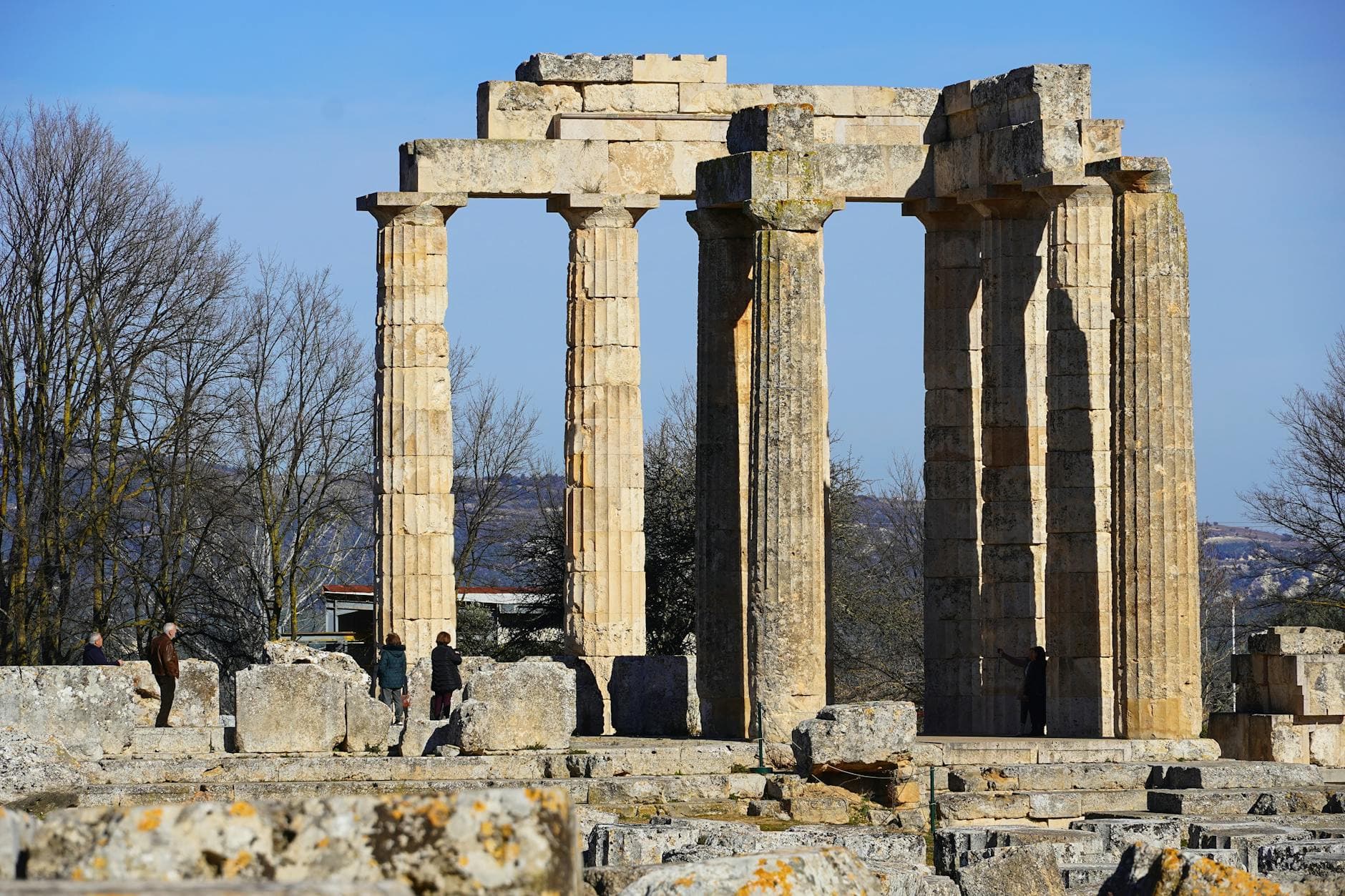
The combination of wine and archaeology here is distinctive. Ancient Nemea — a few kilometres from modern Nemea town — was the site of the Nemean Games, one of the four great Panhellenic athletic festivals (alongside the Olympics, the Pythian Games at Delphi, and the Isthmian Games). The site includes the Temple of Zeus, partially reconstructed with three standing columns, and the ancient stadium — one of the best-preserved ancient stadiums in Greece. The starting line is still intact. The associated museum covers the history of the games and the site.
Combining the stadium visit with a morning of winery visits makes for one of the more complete travel days in the Peloponnese: ancient athletics, excellent archaeology, and genuinely interesting wines. Mycenae is also reachable as a half-day extension — the citadel and the grave circles at Mycenae are a UNESCO World Heritage Site and among the most atmospheric ruins in Greece.
Key villages in the wine route context: Nemea town is the commercial hub and has the most restaurants and basic infrastructure. Koutsi is a smaller village with some estates nearby. Gymnos is the mid-altitude village that gives its name to one of the elevation zones. Asprokambos is the high plateau — more remote, fewer facilities, but worth the drive for the landscape and the wineries based there.
What Nemea Wines Actually Taste Like
Understanding Nemea wine means understanding that the valley does not produce one style — it produces a spectrum, and where a wine sits on that spectrum depends heavily on where the grapes were grown.
Valley floor Agiorgitiko is ripe, soft, and generous. Dark plum and black cherry dominate, sometimes with a jammy note in warm vintages. Tannins are present but not demanding. These wines drink well in their first three to five years. They pair easily with grilled meats, pizza, or anything that benefits from a fruit-forward red without requiring effort. Not wines to cellar for a decade.
Mid-altitude Agiorgitiko adds definition. Fresh cherry sits alongside the darker fruit. There is often a dried herb note — thyme, rosemary — that reflects the garrigue-like scrub in the landscape. Structure is better; acidity provides backbone. These wines work across a range of food situations and can age to eight or ten years in good vintages.
High-altitude Asprokambos Agiorgitiko at its best is a different experience. Violet and pomegranate on the nose alongside deep cherry. The palate shows real grip — tannins that need time to resolve, acidity that gives the wine length and freshness. In warm years these wines can be closed and austere for the first three to five years after release. In cooler years (which at this altitude means late September harvests, not California-level cooling) the aromatics are particularly fine. These are the bottles to put in a cellar and forget for five years.
Rosé from Agiorgitiko is worth a mention. Good examples — Semeli, Gaia, Skouras — are pale salmon-pink, dry, strawberry-driven, with the grape's characteristic freshness. They are not ambitious wines, but they are very good summer drinking and pair well with the local grilled fish, saganaki, and Greek salad.
Food pairings: Agiorgitiko was made for lamb — the Greek tradition of slow-roasted whole lamb at Easter is an obvious reference point, but braised lamb shoulder, lamb chops, and lamb kebabs all work. Loukaniko (Greek pork sausage seasoned with orange peel and fennel) is a classic local pairing. Hard cheeses — graviera, kefalograviera, aged kefalotyri — work well with the mid and high-altitude styles. For lighter Agiorgitiko: roasted chicken, stuffed peppers, grilled vegetables with olive oil.
Buying Nemea Wine
In Greece. Athens has several excellent specialist wine shops where Nemea PDO is well-represented. Oinoscent in Athens (Kolonaki and other locations) stocks a wide range of Greek wines including the better Nemea producers. The wine sections of well-stocked supermarkets (AB Vassilopoulos, Sklavenitis) typically carry Gaia, Skouras, and Semeli at competitive prices — the everyday range wines rather than the reserves.
At the wineries themselves, prices are typically 10-20% lower than Athens retail, and you can buy wines that do not appear in export markets. Worth leaving room in your luggage.
Exporting. UK: Hallgarten Wines and Oddbins have periodically stocked Gaia Wines; check the Gaia website for current UK importers. The Noble Grape and other Greek wine specialists in London carry a broader range. US: importers vary by state due to distribution laws, but Gaia has consistent US distribution. Check wine-searcher.com for current availability in your market.
Shipping wine home from Greece is technically possible but rarely practical. EU wine can be shipped within the EU. Shipping to the UK or US involves customs regulations, and fragile goods handling by Greek courier services is inconsistent. Better to buy a small amount to carry personally and source more through specialist importers.
For context on how Agiorgitiko compares to Old World and New World alternatives, see our Old World vs New World wine guide.
FAQ
Is Nemea worth a special trip from Athens, or is it just an add-on?
It depends on how seriously you take wine travel. For a dedicated wine traveller who wants to understand Greek wine beyond Santorini, Nemea warrants its own trip of two to three days — long enough to visit six or eight producers, see Ancient Nemea, and have some proper meals with the wines. For a visitor whose primary goal is Athens but who wants one good wine day trip, the 90-minute drive is very manageable and delivers significant reward. The archaeology combined with the wine makes it more than a pure wine trip even for people who are primarily tourists rather than wine obsessives.
What exactly is Agiorgitiko?
It is the dominant red grape of Nemea — indigenous to the Peloponnese and rarely grown anywhere else in the world. Named after Agios Georgios (Saint George). Makes wines ranging from light rosé to full-bodied, age-worthy reds. Distinctive for its dark colour, plush red and black fruit, and medium-high tannins that are softer than Cabernet Sauvignon. See the Agiorgitiko section above for full detail.
How does Agiorgitiko compare to Merlot?
Closer to Merlot than to Cabernet in terms of tannin structure and approachability, but distinctly different in character. Merlot tends toward chocolate, plum, and mocha; Agiorgitiko is more red-fruit forward, with cherry and pomegranate alongside the darker fruit, and often has a more herbal, savory note. High-altitude Agiorgitiko is more structured than most Merlot-dominant wines. The comparison is useful as an entry point but the grape stands on its own terms once you spend time with it.
What other Greek wine regions should I visit alongside Nemea?
If you have time in the Peloponnese, add Mantinia for a contrast of white Moschofilero at altitude. For Greek wine more broadly: Santorini for Assyrtiko (the best Greek white, arguably); Naoussa in Macedonia for Xinomavro (the most tannic and age-worthy Greek red); Crete for both indigenous varieties and scale. The full Greece wine region guide covers the national picture.
Is Nemea wine expensive?
By international standards, no. Entry-level Nemea PDO from producers like Skouras and Semeli retails in Greece for €8-14. Mid-range quality — Gaia Notios, Papaioannou estate — runs €15-25. The serious reserves and old vine bottlings reach €30-50, and these prices are genuinely competitive with comparable quality from Rhône, Tuscany, or Rioja. At export prices with importer margin added, expect roughly 30-50% higher than local Greek pricing.
What are the best recent vintages?
2021 and 2019 were strong across the Peloponnese — good growing season conditions with sufficient heat accumulation and no major weather events. 2018 was excellent for the high-altitude zones. 2022 produced some very ripe, generous wines in the valley floor zones. Greek wine producers increasingly note their vintages on back labels, and the trend toward vintage transparency is improving. For specific purchasing advice, ask the winery directly — they know their own bottlings.
Practical Information
| **Main grape variety** | Agiorgitiko (red) |
|---|---|
| **PDO appellation** | Nemea PDO (100% Agiorgitiko) |
| **Other appellations** | Mantinia PDO (Moschofilero), Patras PDO, Mavrodaphne of Patras PDO |
| **Elevation range** | 300–900m above sea level |
| **Drive from Athens** | 85–100 minutes (A8 motorway to Corinth, then A7) |
| **Best months to visit** | May–June (comfortable temperatures); September (harvest) |
| **Tasting fees** | Typically €8–15 per person; advance booking recommended |
| **Nearest city** | Corinth (35km north); Ancient Mycenae (20km east) |
| **Wine tourism infrastructure** | Good; most major estates have organised tasting rooms |
| **Language** | Greek; most winery staff in visitor-facing roles speak English |
For guidance on how to approach winery visits — what to ask, how to taste, etiquette — see our wine tasting etiquette guide. For building a longer itinerary across multiple wine regions, the how to plan a wine tour guide covers the practical framework.
The Peloponnese wine region overview has additional context on the wider region beyond Nemea and Mantinia.


Wines of Nemea & Peloponnese Wine Region: Greece's Best Red Wine Country
Key grape varieties and wine styles produced in the region
Primary Grape Varieties
Wine Styles
Ready to visit Nemea?
Build your personalised day-by-day itinerary — choose your travel style and trip length, get accommodation and tour picks per day, and email it to yourself to take along.
Upcoming Wine Festivals in Greece
See all festivalsHidden Gems Nearby
Discover more hidden gemsBook Your Nemea Wine Country Stay
Compare hotels, vineyard B&Bs and rentals across Booking, Airbnb and more in one search.
Compare stays near the vineyardsStay22
Plan Your Nemea & Peloponnese Wine Region: Greece's Best Red Wine Country Trip
Estimate your Nemea & Peloponnese Wine Region: Greece's Best Red Wine Country trip cost
Budget calculator with accommodation, food, wine, and transport estimates.
Try itCompare Nemea & Peloponnese Wine Region: Greece's Best Red Wine Country with other regions
Side-by-side comparison of cost, climate, wine styles, and more.
Try itWhen to visit Nemea & Peloponnese Wine Region: Greece's Best Red Wine Country
Harvest dates, peak season, and the best months for wine travel.
Try itThis page contains affiliate links. We may earn a commission at no extra cost to you.