Switzerland Wine Guide: Regions, Grapes & Best Wineries to Visit
Switzerland Wine Guide: Regions, Grapes & Best Wineries to Visit
Switzerland produces around 100 million liters of wine per year, an output that sounds substantial until you consider the context: nearly all of it stays within the country. Swiss wine is one of Europe's great kept secrets, not because the quality is mediocre but because the country consumes its own production with an efficiency that leaves very little for export. Estimates suggest that around 98-99% of Swiss wine is drunk within Switzerland. Visitors to the wine regions are often surprised at both the quality and the variety, which rarely resembles the one-dimensional image that the country's limited international presence might suggest.
Switzerland has six distinct wine-producing regions, each shaped by different geology, climate, and cultural influences. The country's four official languages -- German, French, Italian, and Romansh -- correspond roughly to the wine regions, which means a visit to Ticino produces an entirely different experience from one to the Valais or Vaud. The grapes grown, the food paired with the wine, and even the vocabulary for discussing viticulture changes across these linguistic borders.
The country's topography dominates everything. Switzerland is overwhelmingly mountainous, and the best vineyards are carved into south-facing slopes above river valleys and lakes where sun exposure is maximized and cold air drains away rather than settling among the vines. Lake Geneva, the Rhone Valley in Valais, the Rhine, and the Ticino River all create the microclimates that make Swiss wine possible. Without those water bodies and valley channels, the altitude would make ripening impossible across most of the country.
At its best, Swiss wine is genuinely distinctive: Chasselas in Vaud and Valais that carries a mineral, almost watery clarity that no other country replicates; Pinot Noir from Graubunden and Three Lakes with a fine-boned structure that owes more to Burgundy than to Alsace; Merlot from Ticino ripened under Mediterranean light into something full and generous. Swiss wine is worth seeking out not as a curiosity but as a serious category with its own identity.
Valais: Switzerland's Largest Wine Region
The Valais is a long east-west valley carved by the Rhone River through the heart of the Swiss Alps. The valley runs from the headwaters of the Rhone near Brig westward to Martigny, where it turns north and flows into Lake Geneva. The vineyards cling to the steep south-facing slopes on the valley's northern wall, maximizing every hour of sunlight that reaches these high-altitude sites. The valley floor is in the rain shadow of the surrounding Alps, making Valais one of Europe's sunniest and driest growing regions -- the area around Sion receives as little as 600mm of rain per year, with sunshine totals that exceed many parts of Provence.
Valais is Switzerland's largest wine region by area and production. It is also the most geographically dramatic: vineyards at 500-900 meters above sea level, terraced into the schist and granite slopes above the valley floor, give the wines a mineral intensity that reflects the thin, poor soils. The altitude means significant diurnal temperature variation, and the nights are cold even in August, which preserves the natural acidity that keeps Swiss wines fresh.
Chasselas (Fendant)
Chasselas is Valais's most widely planted white grape, sold locally under the name Fendant. This is the same grape that dominates the French-speaking cantons of Vaud and Geneva, but in Valais it takes on a slightly richer, more textured character than in the cooler lake-influenced terroirs to the west. Chasselas wines are characteristically light, dry, and subtly mineral, with a discreet effervescence in some versions that comes from the slight carbon dioxide retained during bottling. They are wines made for drinking with food rather than for contemplation: ideally suited to the Valais tradition of serving them with raclette, fondue, and dried meats.
Pinot Noir and Humagne Rouge
Pinot Noir is the main red variety, and Valais Pinot Noir tends to be fuller and riper than versions grown in cooler parts of Switzerland, though it retains the variety's characteristic elegance when well made. More distinctively Valaisan is Humagne Rouge, an ancient local variety producing dark, somewhat rustic wines with firm tannins and wild berry character. Cornalin (called Rouge du Pays locally) is another indigenous variety producing intensely colored, age-worthy reds with red and black fruit.
Glacier Wine and Rarity
Valais has its own wine curiosity in Vin du Glacier (Glacier Wine), a rancio-style white made in the Val d'Anniviers from old Reze grape plantings. The wine is aged in old oak barrels using a solera-like system, passing through multiple generations, and develops an oxidative, nutty, concentrated character. It is made in tiny quantities by a small community of producers and is rarely found outside the valley. If you encounter it, it represents a direct connection to an Alpine wine tradition centuries old.
The town of Sion, the regional capital, makes a good base for exploring Valais wine country. The surrounding vineyards can be visited on foot, and several producers in and around Sierre and Leuk maintain tasting rooms accessible to visitors.
Vaud: The Terraced Shores of Lake Geneva
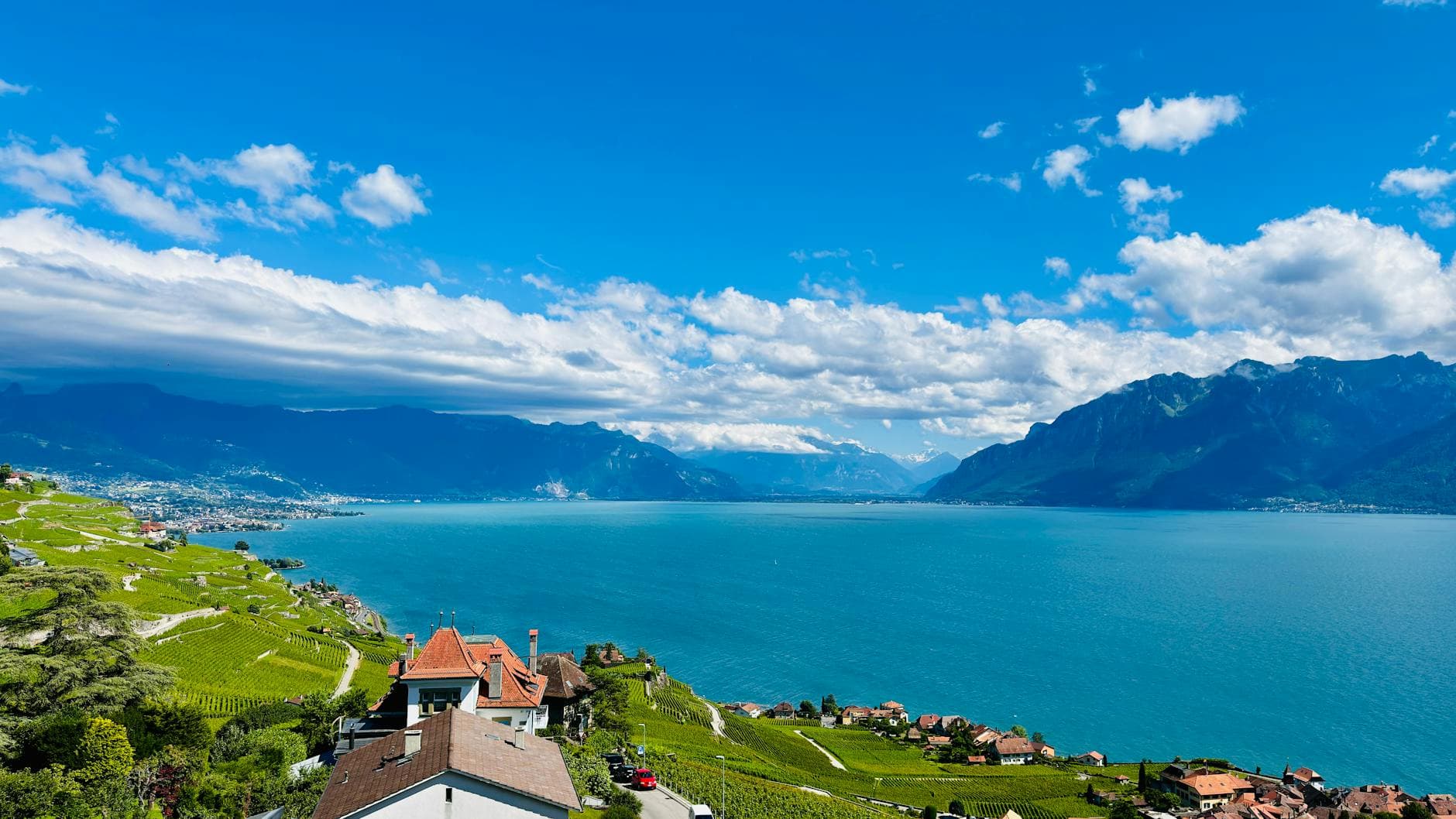
Vaud borders Lake Geneva on its northern shore, and the vineyards here are among the most photographed in Switzerland: the Lavaux UNESCO World Heritage terraces cascade from the village of Lutry east through Epesses, Dezaley, and Calamin to Chardonne, each terrace wall absorbing heat during the day and radiating it toward the vines at night. The lake itself contributes a significant moderating effect, preventing frost in spring and extending the ripening season into October.
The Vaud wine region divides into several sub-regions, the most celebrated of which is Lavaux. The Dezaley grand cru, a small section of terraces between Epesses and Saint-Saphorin, is considered one of Switzerland's finest vineyard sites for Chasselas. The combination of south-facing exposure, schist and limestone soils, heat reflected from the lake below, and the walls' thermal radiation creates conditions that allow Chasselas to achieve a complexity rarely found elsewhere. Dezaley wines have a mineral depth and aging potential unusual for the variety -- they can develop for 5-10 years in bottle, gaining a honey and hazelnut character that surprises those expecting something simple.
Chasselas dominates Vaud plantings, typically labeled with appellation or village names rather than the grape name. The wines from La Cote, the sub-region west of Lausanne toward Geneva, tend to be lighter and more delicate than Lavaux versions, with a fresh, almost neutral quality that makes them excellent aperitif wines. Chablais, east of Lausanne near Aigle, produces Chasselas with more body and a mineral, sometimes slightly smoky character that reflects its limestone soils.
Pinot Noir and Gamay are the main reds in Vaud, often blended to produce the local Salvagnin designation -- a light, food-friendly red made in a style accessible for everyday drinking. Serious Pinot Noir exists in Vaud but is not the region's defining strength.
The lakeside wine villages -- Lutry, Epesses, Rivaz, Saint-Saphorin -- are genuinely beautiful, with terraced vineyards dropping to the water's edge and boats visible on the lake below. The Swiss train system runs directly through the Lavaux on the line between Lausanne and Montreux, providing what may be the most efficient scenic wine region transit in Europe.
Geneva: Innovation at the Lake's Western End
The canton of Geneva sits at the western end of Lake Geneva, where the Rhone flows out of the lake and into France. It is Switzerland's smallest major wine region but has developed a reputation for innovation and experimentation. Geneva producers, working closer to the French wine country of Burgundy, Alsace, and Savoie, have been more willing to experiment with international varieties alongside the traditional Chasselas and Gamay.
The Geneva wine region clusters around the city in three main areas: Mandement to the north (the largest, on limestone soils between the Jura foothills), Arve et Lac to the south and east of the city, and Arve et Rhone between the two rivers west of Geneva. The soils are more varied than in the steep terroirs of Vaud -- flatter, clay-limestone, with deeper soils that retain more moisture. This produces Chasselas with a somewhat softer, rounder character than the taut, mineral versions from Lavaux.
Gamay is widely planted in Geneva and produces the region's most successful reds: light, fruity, often unoaked wines that pair well with the local cuisine and are drunk young. Pinot Noir also performs well on the limestone soils. Geneva producers have also worked successfully with Aligoté, Pinot Gris, and Gewurztraminer as white alternatives to Chasselas.
The city of Geneva itself has an international population that supports a diverse restaurant culture, and the wines from the surrounding region appear on local menus alongside French imports. For visitors, the Geneva wine region is the most accessible for day trips from the city: several producers in the Mandement are under 20 minutes from the centre by public transit.
Three Lakes Region (Drei-Seen-Land)
The Three Lakes region, known in German as Drei-Seen-Land and in French as Trois Lacs, covers the country between Lakes Biel/Bienne, Neuchatel, and Morat (Murten) in the Bernese and Neuchatel cantons. It is a transitional zone between French-speaking Switzerland and German-speaking Switzerland, and the wine style reflects that in-between character: lighter than the bold Valais reds, more structured than much of Vaud's Chasselas.
Pinot Noir and Chasselas are the main varieties. The Three Lakes region produces some of Switzerland's best Pinot Noir, particularly around Neuchatel and on the south-facing slopes of the Bernese Jura. The wines tend toward elegance and transparency rather than concentration: lighter in body than Alsatian Pinot, with good acidity and a silky texture when well made. Neuchatel Pinot Noir has a particularly clear, almost translucent quality that has attracted comparison to basic Burgundy.
Neuchatel is also known for its Oeil de Perdrix, a rosé made from Pinot Noir by a method that extracts only minimal color. The name translates as "partridge eye," describing the pale copper-pink color. It is a local specialty served as an aperitif and rarely found outside the region.
The town of Neuchatel itself sits directly on the lake and has a well-preserved old town with a wine culture integrated into its daily life. The wine festival in September brings the harvest celebration into the town center with processions, music, and the release of the new vintage.
The Bernese shores of Lake Biel/Bienne, particularly around the villages of Schafis, Ligerz, and Twann, produce Pinot Noir and Chasselas from steep terraced vineyards facing south over the lake. The area's German-speaking producers have developed a wine tourism infrastructure that includes a famous cycling route along the lake shore passing through village after village of terraced vineyards.
Graubunden: Eastern Switzerland's Pinot Noir Heartland
Graubunden (Grisons) is the largest canton in Switzerland by area but one of the smallest wine regions by production. The vineyards are concentrated in two main areas: the Rhine Valley (Herrschaft) around Maienfeld, and the Bundner Herrschaft -- a handful of villages that produce what many consider Switzerland's finest Pinot Noir.
The Bundner Herrschaft -- covering Maienfeld, Jenins, Malans, and Flasch -- sits at the point where the Rhine Valley widens above Chur. The soils are limestone and quartzite, the aspect is south to southwest, and the warm south-flowing fohn wind from the Alps extends the growing season and allows full ripening of Pinot Noir at latitudes that should theoretically be too cold. The result is Pinot Noir with remarkable clarity: medium body, fine tannins, bright red fruit, and a mineral backbone that makes Graubunden Pinot a serious wine rather than a curiosity.
The local name for Pinot Noir in Graubunden is Blauburgunder (literally "blue Burgundy"), and the wines are labeled accordingly. The best Malanser Blauburgunder -- named for the village of Malans -- are age-worthy wines with a genuine Burgundian spirit, though they maintain a Swiss precision that differentiates them from Burgundy proper.
Other varieties grown in Graubunden include Pinot Gris, Chardonnay, and some Gewurztraminer, but Blauburgunder is the focus and the regional identity. The area around Maienfeld is associated in Swiss cultural memory with Johanna Spyri's Heidi -- the vineyards, mountain villages, and Alpine scenery form the backdrop of the children's novel, and the Heidi cultural connection brings visitors who discover the wine incidentally.
The wine tourism infrastructure in Graubunden is less developed than in Valais or Vaud, but several producers around Maienfeld and Jenins welcome visitors by appointment. The harvest period in late September to early October is the best time to visit.
Ticino: Italian Switzerland and Merlot's Dominance
Ticino is Switzerland's Italian-speaking canton, separated from the rest of the country by the Alps and sharing a sensibility with Lombardy and Piedmont more than with the French or German cantons. The landscape changes dramatically south of the St. Gotthard Pass: the vegetation becomes Mediterranean, the lake shores are lined with palms, and the light has a warmth absent in the alpine valleys to the north.
Merlot dominates Ticino to an unusual degree, accounting for roughly 80-85% of all wine production. This concentration was not always the case: Ticino grew a variety of red grapes until the 1980s when the VITI quality designation system was established, encouraging Merlot at the expense of other varieties. The system worked: Ticino Merlot, at its best, produces wines of genuine quality that sit comfortably alongside northern Italian reds.
The style varies from the light, easy-drinking Merlot del Ticino DOC wines made for everyday consumption to serious, oak-aged examples from producers who have treated Merlot with the same attention usually reserved for Bordeaux or Tuscany. The best Ticino Merlots have dark fruit concentration, medium-to-full body, soft tannins, and the kind of warmth that reflects the Mediterranean microclimate. Some producers have also made compelling Merlot-based roses.
Several other varieties exist in Ticino: Bondola is an ancient local red grape, rustic and high in acid, that occasionally appears in bottlings but has largely been supplanted by Merlot. Small amounts of Pinot Noir, Cabernet Sauvignon, and Cabernet Franc are grown, often blended with Merlot. Chardonnay and Sauvignon Blanc appear among the whites.
The lakes -- Lugano and Maggiore -- give Ticino its wine tourism character. The lakeside towns of Lugano, Locarno, and Ascona attract visitors for their beauty and climate, and several producers maintain tasting rooms in the wine villages of the Mendrisiotto (the southern wine district near the Italian border) and the Sopraceneri (north of Lugano). The landscape of terraced vineyards above deep blue lakes, with the Alps visible to the north, is genuinely memorable.
Lugano serves as a practical base: international connections, lakeside restaurants serving Ticinese cuisine (polenta, lake fish, braised meats) that pairs well with local Merlot, and proximity to the wine villages of the Mendrisiotto.
Swiss Wine's Key Grape Varieties
Chasselas
Chasselas is Switzerland's signature white grape and its most widely planted variety. Elsewhere it is used primarily as a table grape or for neutral blending wine, but in Switzerland -- particularly in Vaud, Valais, and Geneva -- it is vinified as a serious wine with genuine site expression. The grape's low natural acidity makes it susceptible to oxidation, which Swiss producers manage with attentive winemaking including minimal sulphur. The result, when well made, is a pale, almost translucent white with mineral and floral aromatics, subtle effervescence, and a food-friendly lightness. It is difficult to explain to wine drinkers accustomed to expressive international varieties, but it makes immediate sense with Swiss food -- particularly fondue, raclette, and lake fish.
Pinot Noir (Blauburgunder)
Pinot Noir is Switzerland's most important red variety, grown across the country but at its finest in Graubunden (as Blauburgunder), the Three Lakes region (Neuchatel), and the Valais. Swiss Pinot tends toward a leaner, more precise style than either Burgundy or New World expressions -- the altitude and latitude force restraint. At its best, Graubunden Blauburgunder represents a genuinely distinctive expression of the variety.
Gamay
Gamay dominates Geneva and appears throughout French-speaking Switzerland. Swiss Gamay is typically light and fruity, made in an uncomplicated style for early drinking. It is rarely the focus of serious wine production, but it is ubiquitous at Swiss restaurant tables and at wine festivals, where its approachability makes it the default casual red.
Merlot
In Ticino, Merlot functions as it does in few other places: as the dominant variety around which an entire regional wine culture is organized. Ticino Merlot ranges from simple everyday wine to ambitious, barrel-aged expressions from producers working at the quality level of northern Italy. The best examples have earned international recognition that challenges the assumption that Swiss wine is automatically lightweight.
Arvine (Petite Arvine)
Petite Arvine is a Valais indigenous variety that produces perhaps the region's most compelling white wines. It is aromatic (grapefruit, white flowers, sometimes a distinctive saline mineral quality), naturally high in acidity, and capable of aging for a decade or more in good vintages. Dry versions are the most complex; late-harvest Arvine has become one of Switzerland's most celebrated sweet wines. The variety is rarely found outside Valais, making it one of those wines worth seeking out specifically when in the region.
When to Visit Switzerland Wine Country
September Harvest
September is the optimal month for wine tourism across Swiss wine regions. Harvest begins in Ticino around the first or second week of September and progresses north and east through October. Valais harvest typically runs late September to mid-October for the reds; Vaud follows a similar schedule. The period brings harvest festivals in many wine villages, with the most celebrated being the Fete des Vendanges in Neuchatel (late September) and similar events in Sierre, Sion, and Martigny in Valais.
Summer for Lake Views (June to August)
The Swiss lakes are most beautiful in summer, and the lakeside wine regions of Vaud, Geneva, and Ticino are genuinely attractive destinations independent of wine. The Lavaux terraces in high summer, with the Alps visible across the lake, combine wine tourism with landscape that is hard to match elsewhere in Europe. Temperatures in Ticino and the lower Valais in July and August can reach 30 degrees Celsius, making it feel genuinely Mediterranean.
Spring for Quiet Visits
The spring months (April and May) are quieter, with fewer visitors and producers more available for informal tastings. The vines are budding and the vineyards are greening after winter. Some cellar-door facilities are closed in the weeks immediately after harvest (November to January) as producers focus on winemaking.
Getting Around Swiss Wine Country
Swiss Rail: The Wine Tourist's Tool
Switzerland's rail network is one of the most efficient in the world, and it connects the major wine regions with a directness that removes any need for a car on most wine tourism itineraries. The train line along the north shore of Lake Geneva runs directly through the Lavaux terraces between Lausanne and Montreux -- several small stations (Cully, Epesses, Saint-Saphorin) put you within walking distance of producers. Trains from Zurich reach Chur and the Bundner Herrschaft in under two hours. Lugano in Ticino connects to Zurich via the Gotthard tunnel in just over two hours.
The Swiss Travel Pass, available to foreign visitors, provides unlimited rail, bus, and lake boat travel and makes moving between wine regions straightforward. If the itinerary covers Vaud, Valais, and Ticino -- three linguistically and culturally distinct regions -- a seven to ten day pass allows for a comprehensive circuit.
Lake Boats
The lake steamers on Lake Geneva (operated by CGN) provide an atmospheric way to move between Lausanne, the Lavaux villages, and Montreux. In summer, regular services stop at small lakeside wine villages. The same applies to Lake Constance (Bodensee) in eastern Switzerland, Lake Lucerne, and the Italian lakes in Ticino. Lake travel is slower than rail but considerably more scenic.
Cycling
The Bernese lake shores and the Rhine Valley in Graubunden have well-developed wine cycling routes. The Lake Biel route through the Three Lakes wine villages is particularly well-organized, with signposted paths passing through terraced vineyard villages and connecting to train stations for the return journey. Swiss road cycling infrastructure is generally safe and reliable.
Planning a Swiss Wine Tour
Switzerland is compact enough that a single trip can cover two or three wine regions without excessive travel. A practical circuit for a wine-focused visitor might combine Lausanne and Lavaux (Vaud), then travel east to Sion (Valais) and return via Bern through the Three Lakes, or alternatively travel south through the Gotthard to Lugano and Ticino. Train connections make all these routes feasible without a car.
For those traveling through neighboring wine countries, Switzerland connects naturally with Alsace to the northwest and Austria to the east. The Rhine Valley provides a geographic and cultural continuum between Graubunden Pinot Noir country and the Wachau and Kamptal in Austria; the German and Alsatian wine cultures to the north share varietals and viticultural traditions with German-speaking Switzerland.
Practical tips for planning: see our wine tasting etiquette guide for what to expect at Swiss cellar-door visits, which are typically less formal than French or Italian equivalents but still appreciate advance contact for estate visits. The wine tasting dress code guide covers what to wear for different types of tasting settings -- Swiss producers are generally casual in outlook.
For multi-day wine tour planning across multiple regions, our how to plan a wine tour guide covers the logistics of accommodation, transport, and pacing for wine-focused travel.
FAQ
Why is Swiss wine so hard to find outside Switzerland?
Swiss wine production is relatively small (around 100 million liters annually), and domestic consumption is high enough to absorb almost all of it. The country imports significant quantities of foreign wine while exporting very little of its own. The cost of Swiss wine is also higher than comparable quality from France, Italy, or Spain due to Switzerland's high labor and land costs, making it less competitive in export markets.
What is the most famous Swiss wine?
Chasselas from the Lavaux region, particularly Dezaley grand cru, has the strongest reputation internationally among connoisseurs. Petite Arvine from Valais is also highly regarded by those familiar with Swiss wine. Among reds, Malanser Blauburgunder (Pinot Noir from Graubunden) and Merlot del Ticino have the best reputations internationally.
Is Swiss wine expensive?
By international standards, yes. Swiss wine reflects the country's high labor and production costs. A quality Chasselas from Lavaux or Dezaley costs CHF 15-30 in Switzerland; top Graubunden Pinot Noirs can exceed CHF 50-80. These prices are higher than comparable quality from France or Italy but reasonable in the context of visiting Switzerland, where costs across the board are elevated.
What food pairs with Swiss wine?
Chasselas is the classic partner for cheese fondue, raclette, and Alpine cheese in general. It is also excellent with lake fish (perch, trout, char) and lighter white meat dishes. Valais Pinot Noir and Cornalin pair well with venison, dried beef (Bundnerfleisch), and air-dried meats from the Alpine tradition. Ticino Merlot suits risotto, polenta, braised meats, and the Italian-influenced cuisine of the canton.
Where is the best place to visit Swiss wine country?
Vaud and the Lavaux offer the most scenic combination of wine, landscape, and accessibility -- the train runs directly through the UNESCO terraces. Valais offers the most variety of indigenous grapes and the most dramatic mountain scenery. Ticino is the most Mediterranean in character and has the best weather. For a first Swiss wine trip, Lausanne as a base for Lavaux and Valais (day trip to Sion) covers the two most distinctive regions efficiently.
What is Chasselas wine like?
Chasselas is light, pale, and dry with subtle mineral character. It often has a slight natural effervescence from retained carbon dioxide. The aromatic profile is understated -- white flowers, green apple, a faint nutty quality in aged versions -- and the wine is designed for food pairing rather than standalone sipping. Dezaley Chasselas, the best expression, develops honey and mineral complexity over 5-10 years and is genuinely complex by any standard.
Can you visit Swiss wineries without speaking French or German?
English is widely spoken in Swiss wine regions, particularly in tourist-oriented areas and by younger producers. In the French-speaking cantons (Vaud, Valais, Geneva), French is the default language in tasting rooms, but producers accustomed to international visitors will switch to English easily. In Ticino, Italian is the default; in Graubunden, German predominates. Some basic vocabulary in the local language is appreciated but not required.
When is the Neuchatel wine festival?
The Fete des Vendanges in Neuchatel takes place in late September, typically the last weekend of the month, marking the grape harvest season. It is one of Switzerland's largest wine festivals, with the city center given over to wine tastings, folk processions, and the official opening of the new vintage. Accommodation in Neuchatel books up well in advance for festival weekend.
What is Petite Arvine?
Petite Arvine is an indigenous white grape variety found primarily in the Valais canton. It produces wines with high natural acidity, distinctive aromatics (grapefruit, white peach, a saline mineral quality), and good aging potential. Both dry and sweet versions are made. The sweet late-harvest Arvine is considered one of Switzerland's finest dessert wines. The variety is not grown commercially outside Switzerland and Aosta Valley in Italy.
How does Swiss Pinot Noir compare to Burgundy?
Swiss Pinot Noir -- particularly from Graubunden and the Three Lakes region -- shares Burgundy's emphasis on elegance and site expression over power and concentration. The wines tend to be lighter in body than most Burgundy villages wines, with high acidity, fine tannins, and a precise, clean fruit character. The best Malanser Blauburgunder from Graubunden can hold its own against decent Burgundy village-level wine, though it is a different wine rather than an imitation. Swiss Pinot rarely has the depth of premier or grand cru Burgundy but is often significantly less expensive.
Related guides: Alsace Wine Route Guide | Austria Wine Guide | Wine Tasting Etiquette Guide | Wine Tasting Dress Code | How to Plan a Wine Tour


Book Your Switzerland Wine Guide: Regions, Grapes & Best Wineries to Visit Wine Country Stay
Compare hotels, vineyard B&Bs and rentals across Booking, Airbnb and more in one search.
Compare stays near the vineyardsStay22
Plan Your Switzerland Wine Guide: Regions, Grapes & Best Wineries to Visit Trip
Estimate your Switzerland Wine Guide: Regions, Grapes & Best Wineries to Visit trip cost
Budget calculator with accommodation, food, wine, and transport estimates.
Try itCompare Switzerland Wine Guide: Regions, Grapes & Best Wineries to Visit with other regions
Side-by-side comparison of cost, climate, wine styles, and more.
Try itWhen to visit Switzerland Wine Guide: Regions, Grapes & Best Wineries to Visit
Harvest dates, peak season, and the best months for wine travel.
Try itThis page contains affiliate links. We may earn a commission at no extra cost to you.