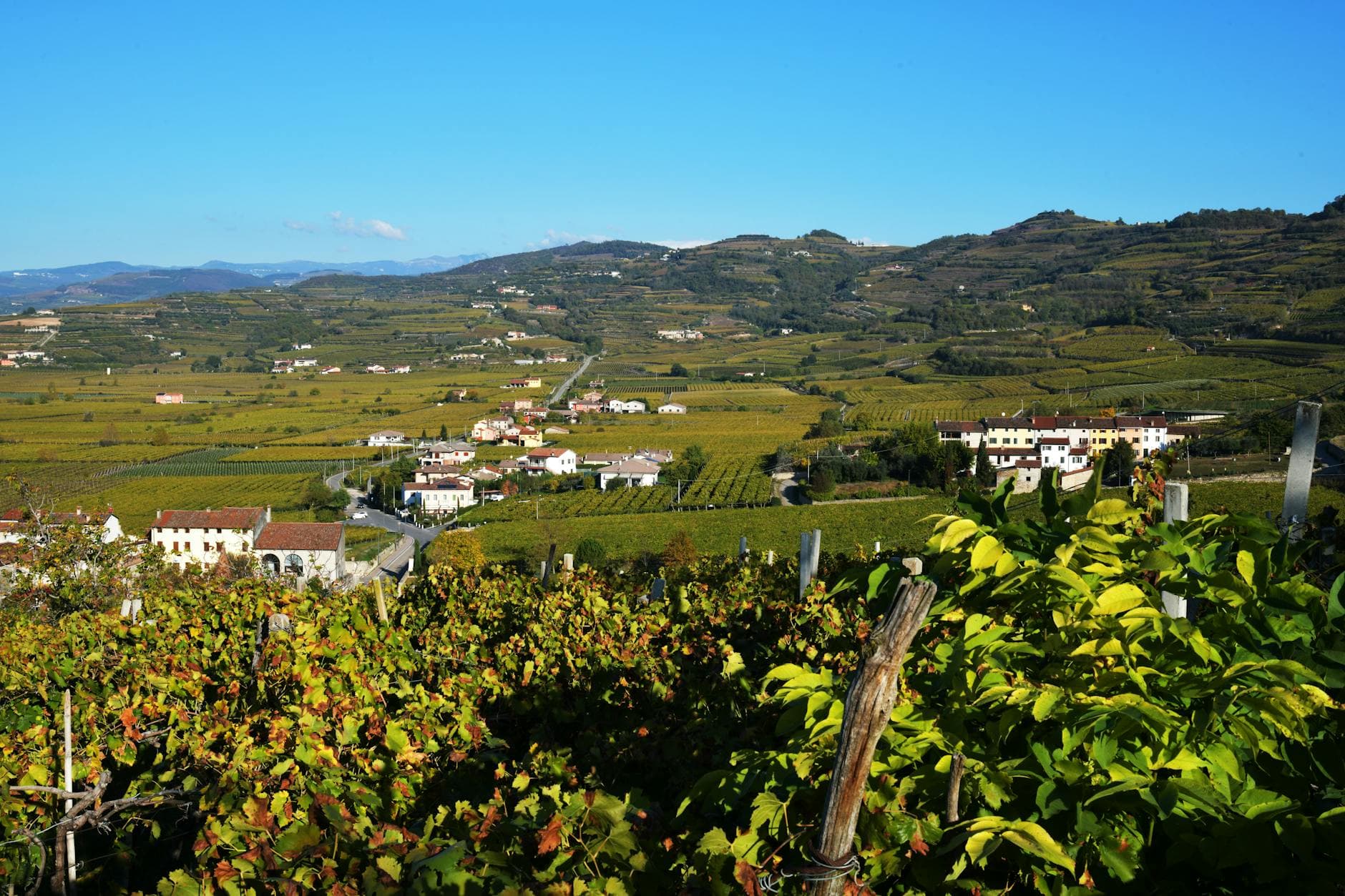
 Photo: Edouard CHASSAIGNE / Pexels
Where to Stay in Veneto Wine Country: Complete 2026 Guide
Find the best places to stay in Veneto for wine lovers. From Prosecco's UNESCO hills to Valpolicella's Amarone heartland and Soave's volcanic whites, discover where to base your Veneto wine trip.
Planning a trip to Veneto?
Compare hotels, vineyard B&Bs and rentals across Booking, Airbnb and more in one search.
Veneto produces more wine than any other region in Italy — and it is not even close. From the sparkling Glera-based Prosecco that fills flutes around the world to the dried-grape intensity of Amarone della Valpolicella, the range here is enormous. Three distinct zones anchor the region: the UNESCO-listed Prosecco hills between Valdobbiadene and Conegliano in the north, the Valpolicella classica slopes northwest of Verona where Corvina grapes are dried on straw mats to make Amarone, and the quiet volcanic soils around Soave where Garganega grapes produce some of Italy's most underrated whites.
Two major cities serve as gateways. Venice, an hour east of the Prosecco hills, needs no introduction. Verona — smaller, less expensive, and home to Roman ruins, Shakespeare's balcony, and a working Roman arena — sits between Valpolicella and Soave with direct access to both. Most visitors fly into one, explore the wine country in between, and fly out of the other. Unlike tightly concentrated wine zones such as the Langhe or Barolo, Veneto's appellations are spread across different landscapes and climates. That spacing means you will likely need to pick a primary base rather than trying to cover everything from one hotel.
Best Areas to Stay in Veneto Wine Country at a Glance:
- For Amarone: Valpolicella / Fumane / Negrar — hilltop villas among cherry orchards and drying lofts
- For Prosecco: Valdobbiadene / Conegliano — UNESCO steep hills, sparkling wine trail
- For white wine: Soave — medieval walled town, volcanic Garganega, peaceful
- For city + wine: Verona — opera, restaurants, Valpolicella and Soave both within 25 min
- For grappa + scenery: Bassano del Grappa / Asolo — northern Veneto, Palladian villas, distilleries
Best Areas to Stay for Wine Tasting
Verona (City Base, Valpolicella & Soave Access)
Verona is one of northern Italy's finest mid-sized cities — Roman arena, medieval churches, an old town that feels lived-in rather than museum-like, and a dining scene built on the surrounding countryside's produce. Romeo and Juliet draw the tour buses, but the real attraction for wine lovers is geography: Valpolicella classica starts 15 minutes northwest, Soave sits 25 minutes east, and the Bardolino vineyards along Lake Garda are 30 minutes west.
Why wine lovers choose Verona:
- Two major wine zones within 25 minutes' drive
- Best restaurant selection in Veneto outside Venice
- Verona's opera season (June–September) at the Arena — pair a matinee with an evening Amarone
- Walkable old town with excellent enotecas (Antica Bottega del Vino is legendary)
- Direct rail from Venice (1 hr), Milan (1.5 hrs), and Bologna (1 hr)
- Vinitaly trade fair in April — the world's largest wine event — is held here
Price range: €90–300/night
Best for: First-time visitors, couples, food and culture lovers, those combining wine with city life
Wine access: No vineyards in the city itself, but Valpolicella and Soave are quick drives. Many urban enotecas stock deep producer selections for walk-in tastings.
Trade-off: You are not waking up in vineyards. Traffic around Verona can be slow during trade fairs and opera season. Parking in the centro storico is restricted.
Where to stay: Delser Manor House Hotel (a converted Roman water cistern in Valpolicella, minutes from central Verona) and Hotel Due Torri (historic, in the city centre) are two named options.
Valpolicella / Fumane / Negrar (Amarone Heartland)
This is where Amarone is made — and the process alone is worth the visit. After harvest, Corvina, Corvinone, and Rondinella grapes are laid on bamboo racks (arele) in ventilated drying lofts (fruttai) for three to four months. The grapes lose 30–40% of their weight, concentrating sugars and flavour compounds, before pressing and a slow fermentation that produces Amarone's signature density and warmth. The classica zone — centred on the villages of Fumane, Marano, Negrar, and San Pietro in Cariano — climbs into the Lessini hills where cherry orchards alternate with vineyard rows and stone-walled villas dot the ridgelines.
Why wine lovers choose Valpolicella:
- Visit drying lofts during appassimento season (November–January) — a process unique to this region
- Top producers: Allegrini, Bertani, Quintarelli (appointment-only, book months ahead), Masi, Dal Forno Romano, Tommasi, Zenato, Tedeschi
- The classica hills above Fumane and Marano are genuinely beautiful — terraced vineyards, stone churches, gravel roads
- Far less touristic than Chianti or the Langhe — you will have many tastings to yourself
- Cherry blossom season (late March–April) turns the hillsides white and pink
- Easy day trip to Lake Garda (30 min) or Verona (15 min)
Price range: €100–350/night
Best for: Serious wine enthusiasts, Amarone collectors, those seeking rural quiet with easy city access
Wine access: Outstanding. Many producers welcome visitors with a phone call or email a week ahead. Quintarelli and Dal Forno require more planning — these are cult producers with long waiting lists. Smaller estates like Brigaldara, Corte Sant'Alda, and Monte dall'Ora offer excellent visits with less formality.
Trade-off: Very limited dining options after dark. Almost no nightlife. A car is essential. Some hill roads are narrow and unsigned.
Where to stay: Dimora del Bugiardo (a country house overlooking the vineyards) and Locanda San Verolo (a converted 18th-century farm) are two named options.
Valdobbiadene / Conegliano (Prosecco DOCG Hills, UNESCO)
The steep hills between Conegliano and Valdobbiadene were added to UNESCO's World Heritage List in 2019, and the landscape earns that recognition. Rows of Glera vines climb slopes so steep that mechanical harvesting is impossible — everything is picked by hand. The road between the two towns (the Strada del Prosecco e Vini dei Colli Conegliano Valdobbiadene, Italy's oldest wine road, established 1966) winds through hamlets where nearly every house has a cantina sign out front.
An important distinction: Prosecco DOCG from these hills is a different product from the mass-produced Prosecco DOC that fills supermarket shelves across Europe. DOCG wines, especially those labelled Rive (single-vineyard) or Cartizze (from a prized 107-hectare sub-zone above Valdobbiadene), show minerality, floral complexity, and genuine character. Tasting the difference on-site is one of the more educational wine experiences in Italy.
Why wine lovers choose Valdobbiadene / Conegliano:
- UNESCO World Heritage landscape — vines on vertiginous green slopes
- Italy's oldest wine road, with over 150 producers along the route
- Cartizze sub-zone tastings: the "Grand Cru" of Prosecco
- Producers like Bisol, Nino Franco, Col Vetoraz, Bortolomiol, and Ruggeri welcome visitors
- Genuinely affordable tastings — many are free or €5–10 for a full flight
- Combine with a stop at the Prosecco school at Conegliano (ISISS Cerletti, Italy's oldest oenology school, founded 1876)
Price range: €70–220/night
Best for: Sparkling wine enthusiasts, budget-conscious travellers, those wanting scenic drives and hiking
Wine access: The easiest wine tasting in Veneto. Most producers along the Strada del Prosecco accept walk-ins or need only a day's notice. Larger houses like Bisol and Nino Franco have structured tour programmes.
Trade-off: An hour from Verona, 1.5 hours from Venice. The area is rural — limited restaurants and services. The wine itself, while excellent DOCG, is still sparkling white; if you want reds, this is the wrong base.
Where to stay: Villa del Poggio Prosecco Bike Hotel (on a hill overlooking the UNESCO Prosecco vineyards) and Relais Althea Azienda Agrituristica (spa, near Vittorio Veneto) are two named options.
Soave (Medieval Town, Volcanic Whites)
Soave is one of Italy's most photogenic small towns — a walled medieval centre crowned by a Scaligero castle, set against hillsides striped with Garganega vines. The wines are criminally underrated. Decades of cheap, mass-produced Soave DOC from the plains damaged the reputation, but classico zone producers on the volcanic soils of the original hillside appellation make whites of real depth: almond-scented, saline, textured, and capable of ageing 5–10 years. Pieropan, Inama, Gini, Prà, and Suavia are among the best.
Why wine lovers choose Soave:
- Arguably the most affordable quality-to-price ratio in Italian white wine
- Volcanic soils (basalt and tuff) give the wines a mineral signature rare in Italian whites
- The walled town is compact, walkable, and genuinely charming
- Far fewer tourists than any other Veneto wine town
- 25 minutes east of Verona, easy to combine
- Pieropan's La Rocca and Calvarino bottlings can stand alongside serious white Burgundy at a tenth of the price
Price range: €60–180/night
Best for: White wine lovers, budget travellers, those wanting a quiet, off-the-radar base
Wine access: Very easy. Several producers have tasting rooms in or adjacent to the town walls. Pieropan and Inama both offer structured visits by appointment. Smaller growers are often happy with a phone call the morning of.
Trade-off: Tiny town — two or three restaurants, limited shopping. If you want reds, Valpolicella is 40 minutes west. Evening activity is essentially zero.
Where to stay: Hotel Roxy Plaza (inside the medieval walls, by the castle) and Monte Tondo Winery (in the hills, with a pool) are two named options.
Bassano del Grappa / Asolo (Northern Veneto, Grappa & Palladian Villas)
Bassano del Grappa sits where the Brenta River exits the Alpine foothills, dominated by its covered wooden bridge (Ponte Vecchio, designed by Palladio). The town is Italy's grappa capital — Poli and Nardini distilleries are both here. Nearby Asolo, a hilltop town once home to poet Robert Browning, calls itself "the city of a hundred horizons." The surrounding hills produce Asolo Prosecco Superiore DOCG (a separate appellation from Valdobbiadene-Conegliano) and the Breganze DOC reds.
Why wine lovers choose Bassano / Asolo:
- Grappa distillery tours at Poli (museum and tastings) and Nardini (Italy's oldest distillery, founded 1779)
- Asolo Prosecco DOCG is less well-known than Valdobbiadene — fewer tourists, similar quality
- Palladian villas dotted across the Brenta valley — Villa Barbaro (Maser) is a UNESCO site
- The Breganze DOC zone produces underrated Vespaiolo whites and Torcolato dessert wines
- Asolo is one of Italy's prettiest small towns, with far fewer visitors than comparable Tuscan hill towns
- Base for combining wine with mountain excursions into the Dolomite foothills
Price range: €70–200/night
Best for: Spirits enthusiasts, architecture fans, travellers combining wine country with mountains
Wine access: Moderate. Grappa distilleries are easy to visit. Wine producers are more scattered; Breganze's Maculan is the best-known estate. Less wine-focused infrastructure than the other Veneto zones.
Trade-off: Furthest from the major appellations — Valpolicella is 50+ minutes, Soave over an hour. More of a side trip than a wine-country base.
Where to stay: Hotel Al Castello (the only hotel within Bassano's historic walls) and Hotel Villa Cipriani in Asolo (a well-known luxury property with a spa) are two named options.
Types of Wine Country Accommodation
Agriturismo (€60–180/night)
Working farms offering guest rooms — sometimes on wine estates, sometimes on cherry, olive, or grain farms. Valpolicella agriturismos frequently include home-cooked dinners with estate wine. Expect thick-walled stone farmhouses, vineyard views, and a pace of life that makes you question your entire schedule.
Best for: Authenticity, home-cooked meals, budget-conscious wine lovers
Villa Hotels (€180–450/night)
Veneto is Palladian country, and several historic villas have been converted into boutique hotels. Expect frescoed ceilings, formal gardens, and a sense of history that modern hotels cannot replicate. Properties in the Valpolicella hills often sit among vineyards with private tasting arrangements.
Best for: Special occasions, couples, architecture enthusiasts
City Hotels in Verona (€90–300/night)
Verona's hotel scene ranges from straightforward business hotels near the Fiera (trade fair centre) to boutique properties in converted palazzi within the old town. The centro storico options put you walking distance from restaurants, enotecas, and the Arena.
Best for: City-and-wine combos, Vinitaly attendees, opera season visitors
Prosecco Road B&Bs (€60–150/night)
Small, family-run bed-and-breakfasts along the Strada del Prosecco. Many are attached to working wineries where breakfast comes with a glass of their own sparkling. Rooms are simple but clean, and hosts often double as impromptu wine guides, pointing you to neighbours and cousins whose cantinas are worth a stop.
Best for: Budget travellers, road-trip itineraries, those who prefer personal over polished
When to Visit Veneto Wine Country
Harvest Season (September–October)
Vendemmia across Veneto's zones, starting with Prosecco's early-ripening Glera in September and finishing with Valpolicella's late-picked Corvina in October. Producers are busy but the energy is electric. Book early — accommodation fills fast.
Appassimento Season (November–January)
Unique to Valpolicella. After harvest, selected grapes are moved to drying lofts. Visiting a fruttaio in November or December — racks of shrivelling grapes filling entire barns — is an experience you cannot get anywhere else in the world. Winter weather, but few tourists.
Spring (April–May)
Cherry blossoms in Valpolicella, wildflowers in the Prosecco hills. Vinitaly takes place in Verona in early April — the trade fair is industry-focused, but satellite tastings and events across the city are open to enthusiasts. Moderate weather, manageable crowds.
Summer (June–August)
Hot in the plains (35°C+), but the Prosecco hills and Valpolicella's higher slopes stay more comfortable. Verona's opera season opens in June. Tourist crowds peak in July–August, particularly around Lake Garda and Venice.
| Month | Weather | Crowds | Prices | Highlights |
|---|---|---|---|---|
| Jan–Feb | Cold, foggy, 0–6°C | Very low | Lowest | Appassimento drying (Jan), quiet tastings |
| Mar–Apr | Mild, 10–20°C | Medium | Medium | Cherry blossoms, Vinitaly (April) |
| May–Jun | Warm, 20–28°C | Medium–High | Medium–High | Ideal weather, opera season opens |
| Jul–Aug | Hot, 28–36°C | High | High | Opera season, Lake Garda day trips |
| Sep–Oct | Warm, 15–26°C | High | High | Vendemmia across all zones |
| Nov–Dec | Cool to cold, 3–10°C | Low | Low–Medium | Appassimento visits, winter menus |
Insider Tips
- Understand the appassimento process before visiting Valpolicella. Amarone is made by drying grapes for 3–4 months after harvest, losing up to 40% of their weight. The resulting wine is 15–16% alcohol, dense, and complex. Ask to see the fruttaio (drying loft) — it is the single most distinctive thing about Valpolicella and most producers are proud to show it.
- Know Prosecco DOCG from Prosecco DOC. DOCG (from the Conegliano-Valdobbiadene hills) is hand-harvested on steep slopes, limited in yield, and genuinely distinctive. DOC (from the flat plains stretching across nine provinces) is industrial-scale sparkling wine. They share a name but not a quality level. When visiting the hills, ask for Rive bottlings (single-vineyard) and Cartizze — the difference will recalibrate what you think Prosecco can be.
- Vinitaly (April, Verona) is the world's largest wine fair. Trade badges are required for the main halls, but Vinitaly and the City — a parallel programme of tastings in Verona's piazzas, restaurants, and enotecas — is open to everyone. If your trip overlaps, do not miss it. Book Verona hotels months ahead; the city fills completely.
- Quintarelli and Dal Forno are cult Amarone producers with waiting lists for both bottles and visits. If you want to see either estate, begin planning 2–3 months in advance. For outstanding Amarone without the exclusivity barrier, try Allegrini, Bertani, Masi, Tedeschi, or Tommasi — all excellent and far more accessible.
- Pieropan in Soave is a mandatory stop for white wine lovers. Their La Rocca bottling (Garganega from volcanic soils, partly fermented in oak) ages beautifully and costs €15–20 at the cellar door. Compare it to a similarly aged white Burgundy costing ten times more.
- Bisol is the benchmark Prosecco producer and their Cartizze bottling is one of Italy's finest sparkling wines. The Bisol family has been growing Glera in the hills above Valdobbiadene since the 1500s. Their Crede bottling (DOCG Brut) is an excellent introduction to serious Prosecco.
- Verona's opera season runs June through September at the Arena, a 1st-century Roman amphitheatre. Pair an afternoon Valpolicella tasting with an evening Aida under the stars. Tickets range from €30 (unreserved stone steps) to €250+ (front stalls). Bring a cushion for the cheap seats.
- Hire a driver for Valpolicella tasting days. The classica zone's roads wind through steep hills with limited signage. Italian drink-driving limits are 0.05% BAC — lower than the US or UK — and enforcement is real. A local driver (€180–250/day) lets you taste properly and knows which unmarked lanes lead to the best small producers.
Book Your Veneto Wine Country Stay
Ready to explore Veneto? Browse curated wine country stays — from Valpolicella hilltop agriturismos to Prosecco road B&Bs and Verona city hotels, all selected for wine lovers.
Whether you are planning a Prosecco trail through the UNESCO hills, an Amarone deep-dive in Valpolicella, or a Soave discovery week in one of Italy's most underrated wine towns, Veneto rewards the curious. It has none of Tuscany's hype and all of the substance.
More Veneto Wine Travel Guides
- Veneto Wine Region Overview
- Valpolicella & Amarone Guide
- Prosecco Wine Guide
- Italy Wine Regions
- Where to Stay in Piedmont
- Where to Stay in Tuscany
Word Count: ~2,400
Last Updated: March 2026
Author: WineTravelGuides Editorial Team


Ready to visit Veneto?
Build your personalised day-by-day itinerary — choose your travel style and trip length, get accommodation and tour picks per day, and email it to yourself to take along.
Upcoming Wine Festivals in Italy
See all festivalsHidden Gems Nearby
Discover more hidden gemsGiuseppe Mascarello e Figlio
WTG PickPiedmont, Italy
One of Barolo's last true traditionalists, producing monopole wines in a garage-sized cellar with zero marketing.
Nebbiolo · Barbera · Dolcetto
Benanti
Sicily, Italy
The original Etna pioneer, predating the volcanic wine hype by decades, with vineyard elevations reaching 1,000 metres.
Nerello Mascalese · Carricante
La Stoppa
Emilia-Romagna, Italy
A natural wine icon in a forgotten corner of Emilia, producing orange wines and skin-contact whites that are pilgrimages for the in-the-know.
Barbera · Bonarda · Malvasia
Book Your Veneto Wine Country Stay
Compare hotels, vineyard B&Bs and rentals across Booking, Airbnb and more in one search.
Compare stays near the vineyardsStay22
Plan Your Where to Stay in Veneto Wine Country: Complete 2026 Guide Trip
Estimate your Where to Stay in Veneto Wine Country: Complete 2026 Guide trip cost
Budget calculator with accommodation, food, wine, and transport estimates.
Try itCompare Where to Stay in Veneto Wine Country: Complete 2026 Guide with other regions
Side-by-side comparison of cost, climate, wine styles, and more.
Try itWhen to visit Where to Stay in Veneto Wine Country: Complete 2026 Guide
Harvest dates, peak season, and the best months for wine travel.
Try itThis page contains affiliate links. We may earn a commission at no extra cost to you.